REVIEW · CIVITAVECCHIA SHORE EXCURSIONS
Civitavecchia Private Cooking Course to Make Pasta
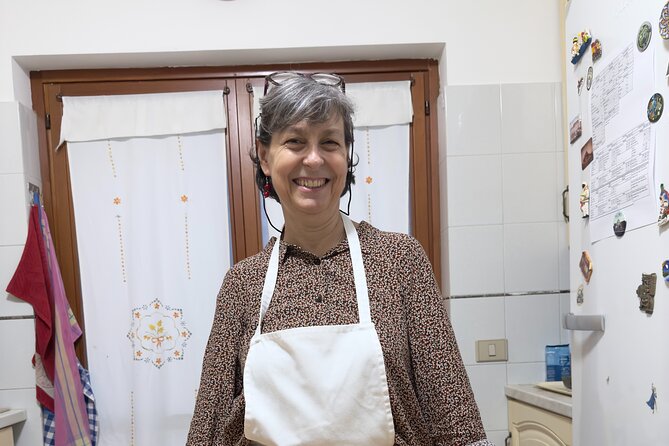
Fresh pasta is the heart of this private class near Lake Bracciano. You start with flour on a wooden board, work the dough by hand, roll it thin, and cut it into tagliatelle and ravioli. Then you try spaghetti alla chitarra, made with a special wire tool called a guitar. Graziella teaches, while Giovanni helps create the warm, family-table setting.
I like the hands-on work and the generous meal that follows. I also like the personal touch: family recipes, seasonal sauces, a bottle of wine for every two people, and dessert made by Graziella. The main drawback is practical: private transportation is not included, so you must arrange your own way to the Civitavecchia meeting point.
Key points to know before booking
- Three kinds of handmade pasta: Prepare tagliatelle, ricotta and spinach ravioli, and spaghetti alla chitarra.
- Traditional tools: Use only a rolling pin for much of the class, then cut spaghetti with the guitar tool.
- Private setting: Only your group takes part, which allows Graziella to watch your dough and help closely.
- Full Italian meal: Your finished pasta is served with sauces, followed by a traditional dessert.
- Wine and coffee included: Expect a welcome drink, wine, unlimited water, and coffee with the meal.
- Plan your own arrival: The meeting point is on Via San Liborio in Civitavecchia, and transport is not part of the price.
Turning flour and eggs into real pasta
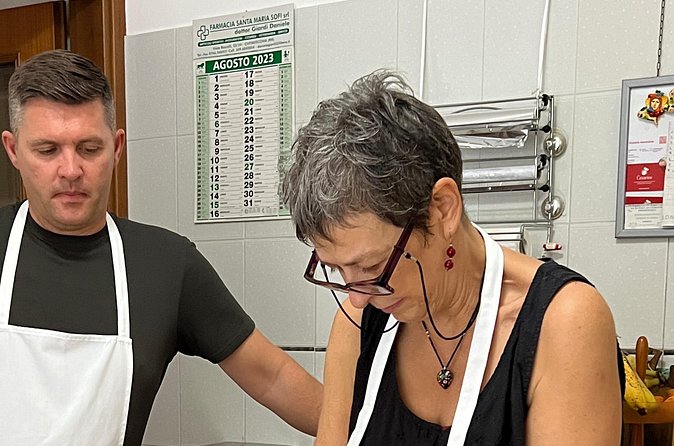
The class begins with the classic fountain of flour on a wooden work surface. You add the ingredients, bring them together, and knead until the dough becomes smooth. This sounds simple. It is not always simple.
The right texture takes feel. You need to notice when the dough is too dry, too sticky, or not yet smooth enough. Graziella’s role matters here because she can correct your technique before the dough becomes difficult to work. One of the most useful parts of the class is learning that pasta is not just a recipe with fixed measurements. It is also a matter of touch and judgment.
You then use a rolling pin to stretch the dough. There is no reliance on a modern pasta machine for the main work. That gives you a better sense of how home cooks traditionally made pasta, and it makes the finished meal feel connected to the effort you put into it.
I would not book this expecting a quick demonstration where you watch someone else cook. You will be working. The dough can take effort to knead and roll, and the process may be messy. That is part of the appeal, but it also means the class suits you best if you enjoy learning by doing.
More Food Shore Excursions in Civitavecchia
- Food Tasty and History Tour in Civitavecchia
★ 5.0 · 256 reviews - Civitavecchia Cultural Walk & Food Sampling
★ 5.0 · 38 reviews - Shore Excursion from Civitavecchia: Walking Tour & Food Tour in Rome with Guide
★ 5.0 · 12 reviews
Tagliatelle, the best place to learn the basics
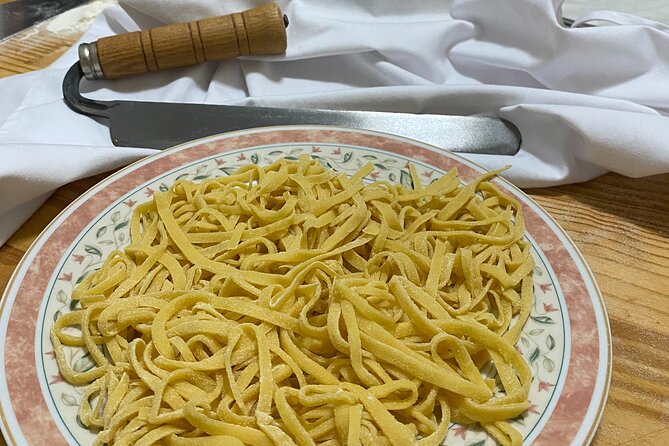
Tagliatelle is the first pasta shape that gives you a clear sense of progress. Once the dough is rolled thin, it is folded and cut by knife into long ribbons. The cuts do not need to look machine-perfect. In fact, small differences are a natural sign of handmade pasta.
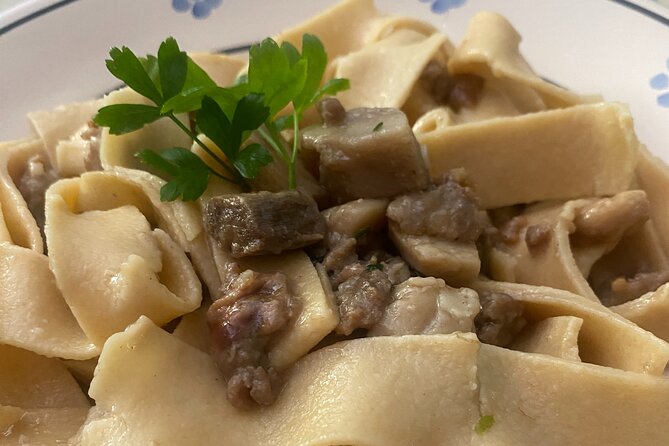
The class uses the tagliatelle with a classic meat sauce. That pairing is familiar for good reason. The broad ribbons hold the sauce well, giving you a satisfying first taste of what you have made.
The work also teaches useful skills you can repeat at home. You learn how thin to roll the dough, how wide to cut the ribbons, and how to keep the strands from clumping. You may find the dough resists you at first. Graziella’s close instruction helps you adjust before you lose patience.
A private class is particularly useful at this stage. Your group does not have to move at the pace of a large cooking school. Graziella can look at your dough, show you where the consistency needs work, and help you get the pasta to the right thickness.
Ricotta and spinach ravioli with butter and sage
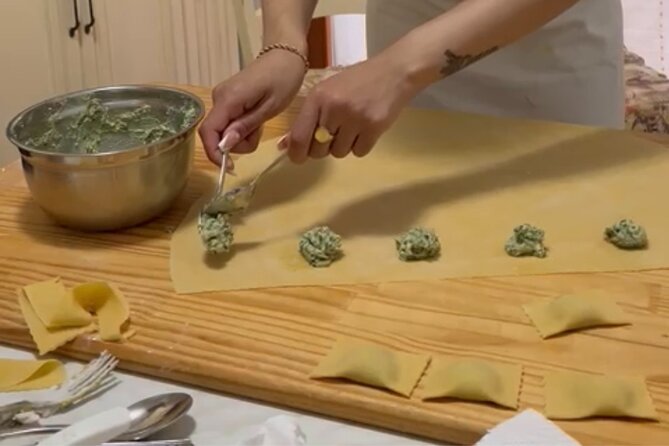
Next comes ravioli filled with ricotta and spinach. This changes the task. Tagliatelle asks for even rolling and cutting, while ravioli also requires care with filling, folding, and sealing.
You will need to place the filling in a way that leaves enough room around each portion. Too much filling makes the ravioli hard to close. Too little leaves you with more pasta than stuffing. Pressing the edges properly matters too, since a loose seal can open during cooking.
The finished ravioli is served with butter and sage. This is a restrained sauce that lets the filling and pasta show through. You are not covering your work with a heavy sauce. The simple seasoning gives you a better idea of the texture of fresh pasta and the flavor of the ricotta and spinach.
This is one of the most useful sections for anyone who wants to recreate the meal later. Ravioli looks polished on a plate, but the class shows you the practical steps behind it. You get a better feel for portion size, dough thickness, and sealing than you would from a recipe alone.
Spaghetti alla chitarra and the guitar tool
The final pasta dough is used for spaghetti alla chitarra. The guitar is a traditional pasta-cutting tool with wires that slice the rolled dough into square-edged strands. It is not a musical instrument, though the name can cause some confusion.
You place the dough over the tool and use the rolling pin to press it through the wires. The result is thicker and more textured than factory-made spaghetti. That texture is useful with sauces because it gives them something to cling to.
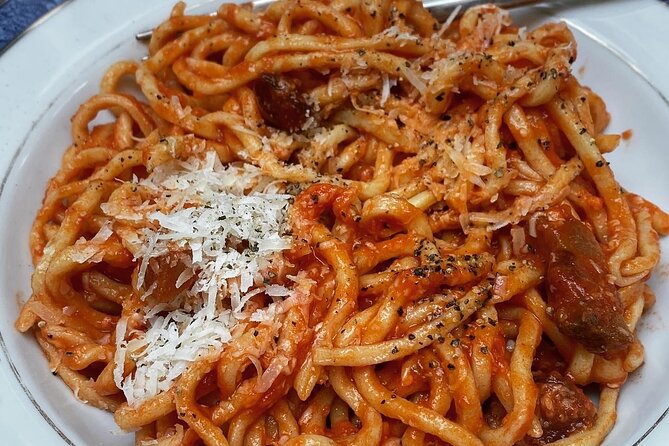
This pasta is served as spaghetti all’Amatriciana, with Amatrice bacon, tomato sauce, and pecorino Romano. The combination is bold and salty, so it gives the meal a different character from the butter and sage ravioli.
The guitar section adds variety to the class. You are not simply repeating the same technique three times. Each pasta asks for a different kind of care, and the guitar gives you a traditional tool to remember after the meal.
More Food Shore Excursions in Italy
- Cooking Class and Market Tour in Civitavecchia
★ 5.0 · 11 reviews - Private Cooking Class with Wine Tasting in a Local Home in Civitavecchia
★ 5.0 · 7 reviews - Dining experience at a local’s home in Civitavecchia with show cooking
★ 5.0 · 5 reviews - From Civitavecchia: Tuscany-Latium Wine Tour with Tastings
★ 4.0 · 4 reviews
The meal is part of the lesson
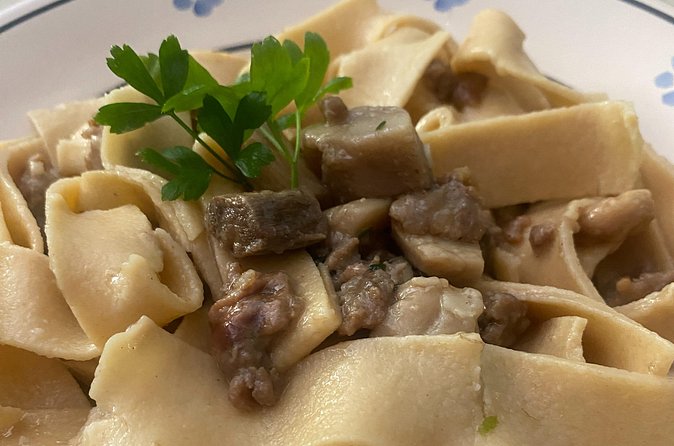
Once the pasta is ready, you sit down to eat it with sauces chosen according to the season and Graziella’s own ideas. The sample meal includes tagliatelle with meat sauce, ricotta and spinach ravioli with butter and sage, and spaghetti alla chitarra with Amatriciana sauce.
That is a substantial meal for a three-hour activity. You are not only making one small dish before leaving. You are tasting several pasta styles, each with a different sauce, then finishing with dessert.
The class includes a welcome drink, a bottle of wine for every two people, unlimited still or sparkling water, and coffee. The wine may be Tuscan red wine such as Chianti Classico or white wine such as Frascati Superior. Alcohol is served only to people aged 18 and over. Younger participants receive soft drinks instead.
The sample aperitif is a glass of Valdobbiadene prosecco, specifically Cartizze, with small bites such as pizza, olives, and cherry tomatoes in oil. The exact condiments can change with the season and Graziella’s plan, so you should treat the sample menu as a guide rather than a fixed promise.
Dessert is tiramisu in the sample menu, made with coffee-soaked ladyfingers and mascarpone cream. The dessert may also come from Graziella’s family or local tradition. That personal element is valuable because it keeps the meal from feeling like a standard restaurant menu.
A private cooking class with a family feel
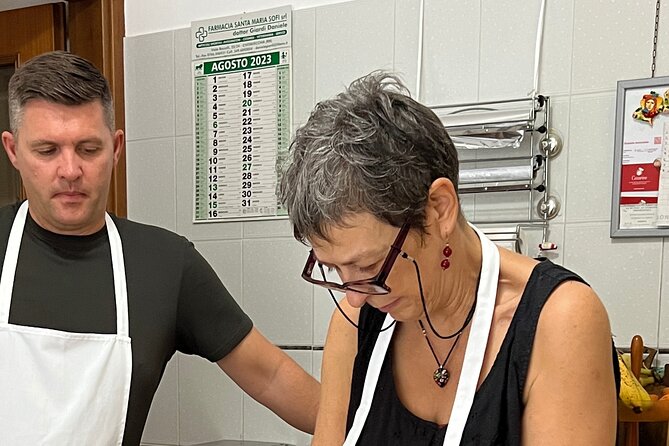
The class is operated by La Cucina di Graziella, with Graziella and Giovanni welcoming your group. The private format means only your party participates. That can make a big difference when you are trying to learn a physical skill.
You can ask for help as you knead, roll, fill, and cut. You are not competing for space at a shared worktable or waiting for an instructor to reach you. The setting also allows the meal to unfold around the same table, which gives the experience a more personal rhythm.
The atmosphere is clearly one of home cooking rather than professional kitchen theater. Graziella’s instruction focuses on the dough and the technique, while the meal draws on family recipes and local tradition. You should expect a social, welcoming experience, but the main attraction remains the pasta itself.
The class has earned particular praise for the quality of the ingredients, the warm hospitality, and the sense of being treated like part of the family. Those details matter because a cooking class can easily become a basic recipe lesson. Here, the meal and the people around it are a major part of the value.
What the three-hour schedule means for you
The activity lasts about three hours. That is enough time for a substantial lesson and meal, but not so long that the cooking becomes an all-day commitment.
You should expect the time to include preparation, instruction, shaping several types of pasta, cooking, eating, dessert, and drinks. Since the class is private, the pace may feel more relaxed than a large group session, though the amount of food and hands-on work means you should arrive ready to take part.
The meeting point is on Via San Liborio in Civitavecchia. The activity ends back at that same meeting point. Private transportation is not included, so you need to arrange your own arrival and departure. The location is near public transportation, but no specific transfer service is provided.
This point deserves attention if you are fitting the class into a tight day. Do not assume that transport from a hotel, cruise port, or another town is included. Confirm how you will reach Via San Liborio before booking.
Is $193.49 a fair price?
At $193.49 per person, this is not a budget cooking lesson. The price makes more sense if you value a private setting and a complete meal, rather than a short group class focused on one recipe.
You receive roughly three hours of instruction, several pasta preparations, a welcome aperitif, wine for every two people, water, coffee, dessert, and the finished meal. The private format also means the cost covers a more personal experience for your group instead of a seat in a large class.
The value is strongest for people who want food, conversation, and instruction in one outing. If you only want to learn how to make tagliatelle, you may find the price harder to justify. If you want to practice three pasta styles and sit down to a full Italian meal, the package is easier to appreciate.
The wine and multiple courses add to the value, but the real question is how much you value personal instruction. You are paying for Graziella’s attention, the home-style setting, and the chance to make the meal yourself.
Who will enjoy this most
I would recommend this for couples, families, and small private groups who enjoy food and do not mind getting their hands into the dough. It also suits you if you want a cultural activity connected to local cooking rather than another sightseeing stop.
The class can work well for beginners because you do not need advanced pasta skills to take part. The instruction covers the dough, rolling, cutting, filling, and use of the guitar tool. You should still be comfortable with a hands-on activity that requires some effort.
It may be less suitable if you want a fast, polished demonstration, dislike working with flour, or have a very limited schedule after the class. You should also note the warning about cat allergies. People with cat allergies may not find the setting suitable.
The activity is offered in English, which makes the instruction accessible to English-speaking participants. Alcohol is limited to adults, and the class can accommodate younger participants with soft drinks instead.
Booking and cancellation details
Confirmation is provided when you book. You can cancel for a full refund if you do so at least 24 hours before the experience begins. Cancellations or changes made within 24 hours are not accepted for a refund, and the cut-off follows local time.
Because the activity is often booked well in advance, with an average booking lead time of about 118 days, you may want to reserve early if your dates are fixed. The private format has limited capacity by nature, so last-minute availability may be harder to find.
Should you book this pasta class?
Book it if you want more than a meal. You will knead the dough, struggle a little with the consistency, learn how to roll and cut it, shape ravioli, use the chitarra, and then eat the results with wine and dessert.
The strongest reasons to choose it are the private instruction from Graziella, the three different pasta styles, and the personal family-table setting with Giovanni. The main reasons to hesitate are the price and the need to arrange your own transport to Civitavecchia.
For a food-focused day near Lake Bracciano, this is a worthwhile choice for people who value participation and personal attention. If you prefer a cheaper class, a shorter demonstration, or a fully arranged transfer, this may not be the right fit. If you want to leave with flour on your hands and a better understanding of how fresh pasta is made, it is a strong pick.
FAQ
Where does the cooking class meet?
The meeting point is Via San Liborio, Via S. Liborio, 00053 Civitavecchia RM, Italy.
Where does the activity end?
The class ends back at the meeting point in Civitavecchia.
How long does the cooking class last?
The experience lasts approximately three hours.
Is the class private?
Yes. Only your group participates in the activity.
Which types of pasta will I make?
You will make tagliatelle, ricotta and spinach ravioli, and spaghetti alla chitarra.
What tools are used during the class?
The pasta is made by hand with a rolling pin, wooden work surface, knife, and the traditional guitar tool for spaghetti alla chitarra.
Is wine included?
Yes. The class includes alcoholic beverages, including Tuscan red wine such as Chianti Classico or white wine such as Frascati Superior. A bottle is provided for every two people.
Are drinks included for participants under 18?
Yes. Participants under 18 receive soft drinks instead of alcoholic beverages.
Is transportation included?
No. Private transportation is not included. The meeting point is near public transportation.
Can I cancel for a full refund?
Yes. You can receive a full refund if you cancel at least 24 hours before the experience start time. Changes or cancellations made less than 24 hours before the start are not accepted for a refund.
More Private Shore Excursions in Italy
- Post Cruise Private Tour from Civitavecchia to Rome visit All Major Attractions
★ 5.0 · 29 reviews - Half-Day Private Rome Tour Civitavecchia Port to Airport
★ 5.0 · 26 reviews - Private and Customisable tour of Rome from Civitavecchia
★ 5.0 · 26 reviews - Private Shore Excursion Civitavecchia: Best of Rome and Vatican
★ 5.0 · 21 reviews
More Private Shore Excursions in Civitavecchia
- Civitavecchia Shore Excursion: Best of Rome Private Tour
★ 5.0 · 247 reviews - Private Shore Excursions to Rome from Civitavecchia Cruise Port with Driver
★ 5.0 · 118 reviews - Private DayTour of Rome from Civitavecchia port van Mercedes V class
★ 4.5 · 62 reviews - Private Tour of Rome from Civitavecchia
★ 5.0 · 30 reviews
Newly added around Lake Bracciano
- Umbria and the Etruscan Land Shore Excursion from Civitavecchia Port★ 5.0 · 8 reviews
- Rome in one day: tour from the cruise port Civitavecchia★ 5.0 · 16 reviews
- Wine and Cheese Tastings Southern Tuscany ShoreExcursion from Civitavecchia Port★ 5.0 · 2 reviews
- from Civitavecchia Skip the line Vatican Museum, Sistine Chapel, St Peter★ 4.0 · 10 reviews
- From Civitavecchia: Tuscany-Latium Wine Tour with Tastings★ 4.0 · 4 reviews
- Sightseeing Tour of Rome from Civitavecchia Port★ 5.0 · 6 reviews
- from Civitavecchia: Saturnia natural hot springs experience★ 4.0 · 9 reviews
- Private Etruscan History Tour from Civitavecchia: Tarquinia and Tuscania★ 4.5 · 12 reviews
Civitavecchia Shore Excursions, compared.



Panoramic Tour of Rome by Bus from Civitavecchia
Read our review →