
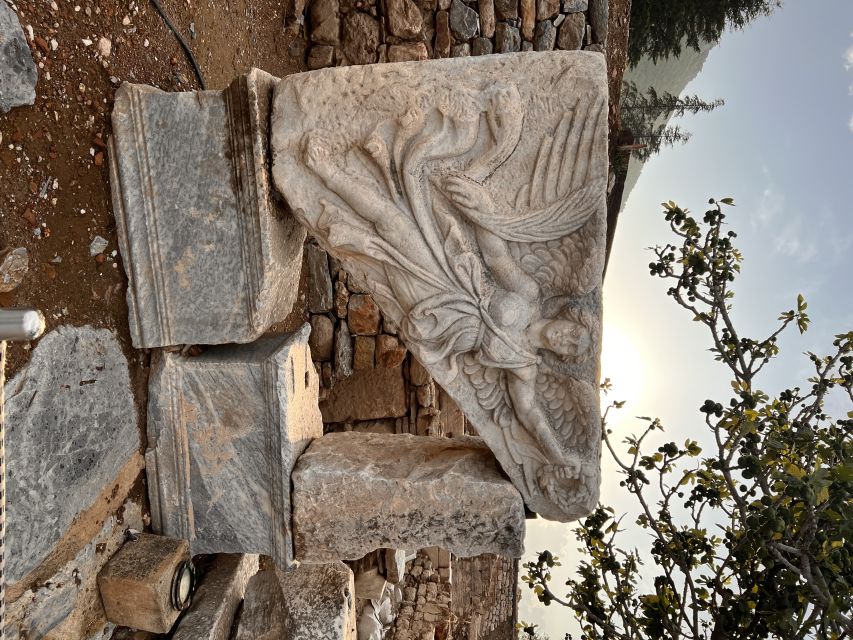
REVIEW · KUSADASI SHORE EXCURSIONS
Ephesus & Mary’s House & Artemission Tour for Cruisers
Ephesus is the star here, and for good reason. Its marble streets, vast theater, Roman baths, and beautifully restored Celsus Library make the ancient city easy to picture. The tour also adds the Temple of Artemis and Mary’s House, giving you three very different stops in one cruise-friendly day.
I like the private-group option and the easy port pickup, especially when your ship gives you only a few hours ashore. I also like that the guide handles skip-the-line tickets and that guides such as Koray Yasa have been praised for making the history clear and personal. The main catch is cost: the $80 tour price does not include admission fees, and the included lunch may come with rug and leather sales visits.
Key points at a glance
- Ephesus is the main event: See the Celsus Library, Great Theater, Odeon, Roman Baths, Hadrian’s Temple, Trajan’s Fountain, and other ruins.
- The Temple of Artemis is a quick but meaningful stop: One of the Seven Wonders of the ancient world, now represented by a small surviving section.
- Mary’s House adds a religious dimension: Visit the hilltop site associated with Mary’s final years, though its history remains a matter of tradition and faith.
- Cruise timing is built in: Meet at the main Kusadasi Port gate and return to the port after roughly six hours.
- Lunch is included, with a condition: The meal may be paired with a Turkish rug demonstration and sales presentation.
- Budget for admission: Ancient Ephesus costs 40 euros per person and Mary’s House costs 15 euros per person, paid separately.
Why Ephesus deserves your limited shore time
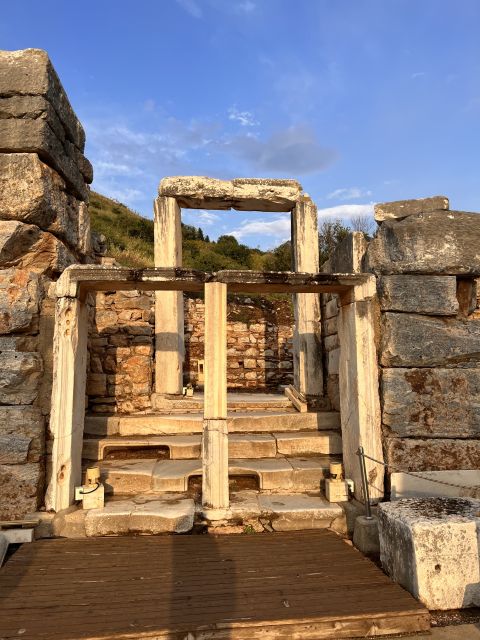
Ephesus is one of the best-preserved ancient cities in the region, and it gives you more than scattered columns. You walk through a city once shaped by Greek, Hellenistic, Roman, and later Christian life. The surviving streets and public buildings show how people moved, governed, worshipped, bathed, and watched performances.
The setting also makes the site easy to understand. Your guide can point out how the major buildings related to one another instead of leaving you to puzzle over isolated stones. The Odeon, for example, was used for meetings of the advisory council. The Roman Baths show how public life extended beyond temples and monuments.
The ancient city is the part of the day where a guide earns the fee. Names such as Celsus Library and Great Theater are familiar, but their scale means more when someone explains how they functioned. A strong guide can help you separate confirmed history from later stories, which is especially useful at sites connected with religious tradition.
One practical point: the ancient city is not ideal for anyone with major mobility limits. You should expect to walk over uneven ancient surfaces, and comfortable shoes matter. The tour is described as unsuitable for people with mobility impairments, so consider your footing and stamina before booking.
More Ephesus excursions in Selcuk:
- Shore Excursions: 3 Hours Easy Ephesus Tour
★ 4.5 · 136 reviews - Kusadasi Shore Excursion : Ephesus Private Tour ONLY FOR CRUISE GUESTS
★ 5.0 · 101 reviews - Ephesus Shore Excursion: Private Guide and Vehicle
★ 4.5 · 98 reviews
Walking down Ephesus’s marble streets
The visit to Ephesus usually includes the Odeon, Roman Baths, Hadrian’s Temple, Trajan’s Fountain, the Celsus Library, and the Great Theater. You will also see many columns, monuments, and fallen architectural pieces spread along the route.
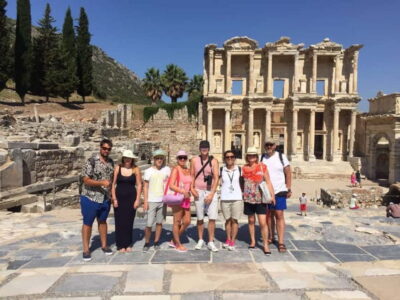
The Celsus Library is likely to be your most photographed stop. Its two-story facade has been partly reconstructed, with columns and carved details that give you a strong sense of the building’s former elegance. It was more than a place to store scrolls. The facade was designed to impress, and it still does.
Hadrian’s Temple is smaller but finely decorated. Its surviving details reward a slower look, especially if your guide explains what is original, what has been reconstructed, and how Roman rulers were honored in public spaces. Trajan’s Fountain and the other monuments help fill in the everyday scale of the city.
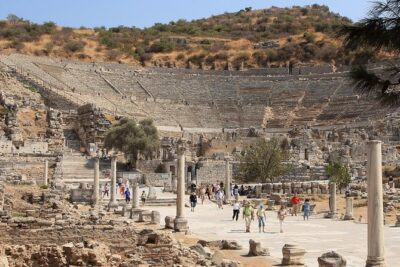
The Great Theater is the most dramatic space on the route. Its size makes it clear that Ephesus was not a minor settlement. You can picture large public gatherings there, though the exact experience depends on how much time your guide allows and how busy the site is that day.
The tour description calls this a visit to one of the best-preserved ancient cities in the world. That is a fair way to think about it, but do not expect an untouched city. Some structures are ruins, some are reconstructed, and some survive mainly as fragments. The pleasure is in reading the remains together.
The Temple of Artemis, one surviving reminder
The Temple of Artemis is often described as one of the Seven Wonders of the ancient world. That title can create a problem: you may arrive expecting a complete temple and find only a remnant of the former site.
That contrast is exactly why the stop works best when you know what you are seeing. The temple was once a major religious and architectural achievement, but very little remains in place today. Your guide can provide the missing scale and context, helping you picture why ancient writers considered it extraordinary.
This is generally a shorter stop than Ephesus. I would treat it as a valuable historical pause rather than the centerpiece of the day. If you have limited time, Ephesus gives you far more to explore physically, while Artemis gives you a chance to connect the modern stop with the ancient world’s list of wonders.
The stop also adds variety. Ephesus is a city with streets and buildings. Artemis is a reminder that archaeology can be about absence as much as surviving walls.
Mary’s House on Mount Nightingale
The tour continues to the House of Mother Mary on Mount Nightingale, a hilltop location associated with Mary’s later years. The site has religious importance for many visitors, but you should understand the nature of the claim before you go. The house is connected to Christian tradition and pilgrimage, not a universally proven fact.
That distinction does not make the visit pointless. For many people, the quiet setting and devotional atmosphere matter as much as the archaeology. For others, the evidence may feel less convincing than what they see at Ephesus. I would approach it as a place of faith and tradition rather than as a certain historical conclusion.
The tour information lists the admission fee at 15 euros per person. The guide prepays skip-the-line tickets, and you can reimburse the guide in cash using euros, dollars, or Turkish lira. Ask your guide to clarify the exact ticket total before entering so you can keep your budget straight.
If Mary’s House is not a priority for you, ask in advance about alternatives. One family chose the Ephesus Museum instead and found it a much stronger use of time. The museum is not described as a standard stop on this tour, so do not assume a substitution is included. Still, it is worth asking, particularly if you prefer original artifacts to a religious site.
More shore excursions in Selcuk:
- EPHESUS TOUR From Cruise Port: Private Tour & Skip The Line
★ 5.0 · 65 reviews - Private Tour : Biblical Ephesus Tour for Cruisers from Kusadasi ( Ephesus ) Port
★ 5.0 · 55 reviews - Shore Excursions: Half Day Ephesus & Şirince Village Tour
★ 4.9 · 39 reviews - Kusadasi: Private Ephesus Tour with Lunch for Cruisers
★ 4.7 · 36 reviews
Lunch, rugs, and the sales pitch
Lunch at a local restaurant is included, which is helpful during a six-hour excursion. You do not have to lose time searching for a meal, and a scheduled stop keeps the day moving for cruise passengers.
The important detail is that the lunch may be linked to a rug-weaving school and demonstration. You may see how Turkish rugs are made, then hear a sales presentation. The rugs can be attractive, and the prices may look good compared with other shopping stops in Turkey, but the lunch is not entirely free of strings.
I would decide before arriving how much shopping time you want to give away. If you are interested in Turkish carpets, this could be a useful chance to learn about them and compare prices. If you mainly want ancient sites, make your limits clear and do not feel obliged to buy.
The afternoon may also include a fashion show at a leather manufacturing shop. Again, this can be interesting if you want Turkish leather goods, but it is not sightseeing in the same sense as Ephesus. The more important your ship departure time, the more directly you should ask how long these commercial stops will last.
Port pickup and the six-hour schedule
You meet your English-speaking guide in front of the main gate of Kusadasi Port. The guide then takes you by air-conditioned, non-smoking vehicle to the sites and returns you to the port afterward. Transfer service from a Kusadasi hotel is also listed, but a hotel supplement may apply.
For a cruise passenger, that port-to-port arrangement is the biggest practical advantage. You are not piecing together taxis, buses, and site tickets on your own. The guide also carries prepaid skip-the-line tickets, which helps avoid waiting at the entrances.
The tour lasts about six hours, though the exact starting time depends on availability. Since your ship’s all-aboard time matters more than the advertised duration, confirm the return plan before you leave the port. A private group gives you more control over stops and pace, while a small group may cost less but offer less flexibility.
The tour runs rain or shine. Bring a hat, sunglasses, a charged smartphone, and a camera, but leave the tripod behind. A passport or copy is requested, and comfortable walking shoes are essential.
What the $80 price really covers
The advertised price is $80 per person. That includes a professional English-speaking guide, port or hotel transfers, air-conditioned transportation, parking, and lunch. Those inclusions make the price reasonable for a shore excursion, particularly if you are traveling in a private group and value having the transport organized.
But the headline price is not your final cost. Ancient Ephesus requires an additional 40 euros per person, and Mary’s House requires another 15 euros per person. Together, the listed admission fees add 55 euros per person, paid separately from the tour price.
There may also be a tour supplement: $50 for each private group or $10 per person for small groups, paid in cash to the guide. Confirm which charge applies to your booking. You should also carry cash in euros, dollars, or Turkish lira for site tickets and any personal purchases.
The tour guide has prepaid the tickets to save you from waiting in line, but you still pay the guide for the entry costs. That arrangement is convenient, though it means you need to understand the full cash requirement before leaving the port.
The guide makes the difference
Ephesus is the kind of place where a guide can turn a collection of ruins into a readable city. A guide such as Koray Yasa has been praised for explaining Turkey and its past in a way that made the day memorable. The tour is offered in English, and a private group is available.
I would use the guide actively. Ask about the difference between the Greek, Roman, and later Christian periods. Ask which sections are reconstructed. Ask how much time remains before the next stop. Good questions help you get more than a quick sequence of photo stops.
The tour is also suitable for families who want a simpler day. One family with children found Ephesus to be the best part of its cruise stop, and that makes sense: the Great Theater and huge library are easier for younger visitors to grasp than a museum label filled with dates.
Still, you should not expect unlimited time. The same family wanted to stay longer. Six hours must cover driving, three major sightseeing areas, lunch, and commercial stops. If Ephesus is your main goal, tell the guide early that you want to protect time there.
Who should book this Ephesus tour?
I would recommend this tour to cruise passengers who want the major Ephesus sights without arranging transport themselves. It suits families, first-time visitors, and anyone who wants an English-speaking guide to handle the route, parking, and skip-the-line tickets.
It is also a good fit if you want several types of stops in one day: a major archaeological city, an ancient wonder site, and a place tied to Christian tradition. The private-group option is useful for families or friends who want to adjust the pace.
I would be more cautious if you dislike shopping presentations, have limited walking ability, or want to spend every minute at archaeological sites. The rug and leather stops may reduce your sightseeing time, and the total cost is higher than the initial $80 once admission and supplements are added.
Cancellation is free up to 24 hours before the tour, and reserve-now, pay-later booking keeps your plans flexible. Those terms help if your cruise schedule is uncertain, but they do not remove the need to check your ship’s port timing.
Should you book it?
Book this tour if your priority is a well-organized Kusadasi shore day built around Ephesus. The Celsus Library, Great Theater, and Roman-era streets are worth the trip, and the guide can add context that you would miss on your own.
Before paying, confirm three things: the full cost after admissions and supplements, how much time is reserved for Ephesus, and whether the rug and leather visits are required. If you accept those conditions, this is a practical way to see the region’s main ancient sites in six hours. If you want a slower archaeological visit or prefer museums to religious and commercial stops, ask about a more focused alternative.
FAQ
Where does the tour meet?
Your guide meets you in front of the main gate of Kusadasi Port. The meeting point can vary depending on the option booked.
How long does the tour last?
The tour lasts about six hours. Starting times depend on availability.
What admission fees are extra?
Ancient Ephesus costs 40 euros per person, and the House of Mother Mary costs 15 euros per person. These fees are not included in the $80 tour price.
How are the site tickets paid?
The guide prepays skip-the-line tickets. You pay the entry costs directly to the guide in cash, using euros, dollars, or Turkish lira.
Is lunch included?
Yes. A complimentary lunch at a local restaurant is included. The lunch may be connected with a Turkish rug demonstration and sales presentation.
Is the tour private?
A private group option is available. Small-group tours are also offered, and a supplement may apply depending on the group type.
What should I bring?
Bring comfortable shoes, sunglasses, a hat, a camera, a charged smartphone, and your passport or a copy. Tripods are not allowed.
Newly added around Selcuk
- Shore Excursions: Half Day Ephesus & Şirince Village Tour★ 4.9 · 39 reviews
- Kusadasi: Private Ephesus Tour with Lunch for Cruisers★ 4.7 · 36 reviews
- PRIVATE Ephesus Tour for Cruisers | Guaranteed Port Return★ 4.7 · 9 reviews
- Kusadasi Cruise Port: Best of Ephesus Tour | Skip-The-Line★ 4.8 · 10 reviews
- From Kusadasi: Daily Ephesus Tour for Cruise Passengers★ 5.0 · 3 reviews
- From Kusadasi : Ephesus Tour – Tailored for Cruisers★ 5.0 · 4 reviews
- For Cruisers: Ephesus Tour (Skip the line)★ 5.0 · 5 reviews
- FOR CRUISERS: Highlights of Ephesus Tour (Skip-the-line)★ 5.0 · 6 reviews
Kusadasi Shore Excursions, compared.
FOR CRUISERS: Skip The Lines PRIVATE EPHESUS TOUR &On Time Return
Read our review →
Top Choice For Cruisers: Ephesus, Mary’s House WITH TICKETS+LUNCH
Read our review →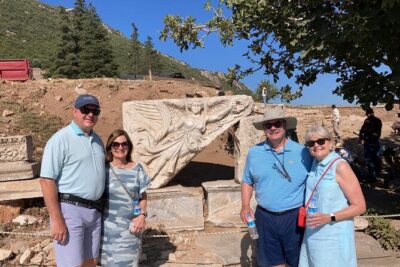
PRIVATE EPHESUS TOUR FOR CRUISERS: On-time Return and Skip-Line
Read our review →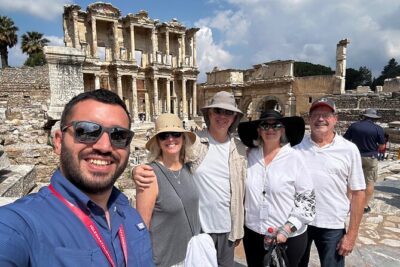
ALL INCLUDED: Ephesus Ruins, Mary’s House Tour incl ENTRY TICKETS
Read our review →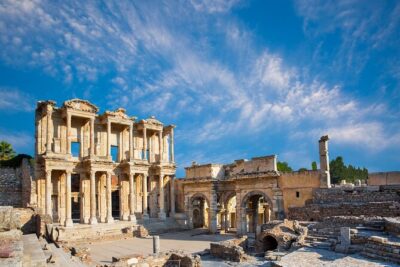
PRIVATE TOUR FOR CRUISERS: Mary’s House (Meryemana) and Ephesus
Read our review →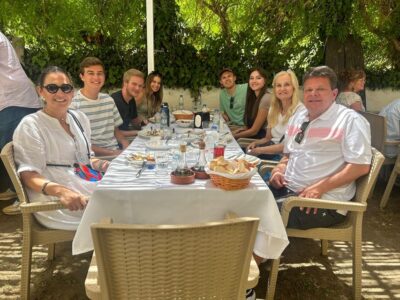
Top-Rated Ephesus and House of Virgin Mary Tour for Cruisers
Read our review →Browse the lists this tour appears in