
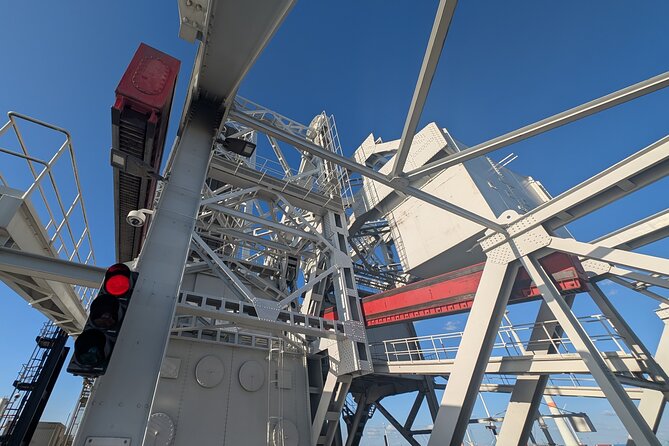
REVIEW · SHORE EXCURSIONS
Guided Antwerp Port Tour, in your Car or Minibus
Antwerp’s port is far too large to understand from the city center. This private drive takes you from Zaha Hadid’s Havenhuis and historic dry docks to giant sea locks, chemical plants, rail yards, and container terminals. I like the way the tour shows both the working port and the human stories behind it, especially at Lillo Fort, where old fishermen’s houses sit beside one of Europe’s biggest industrial zones. I also like that your own car lets you cover ground quickly without being packed onto a large coach.
The main drawback is simple: you must provide the vehicle. The guide boards your car or minibus, and the tour is best for people who enjoy explanation and observation more than long walks or formal museum visits. Some sights are quick drive-bys, and port activity depends on timing and weather.
Key points before you book
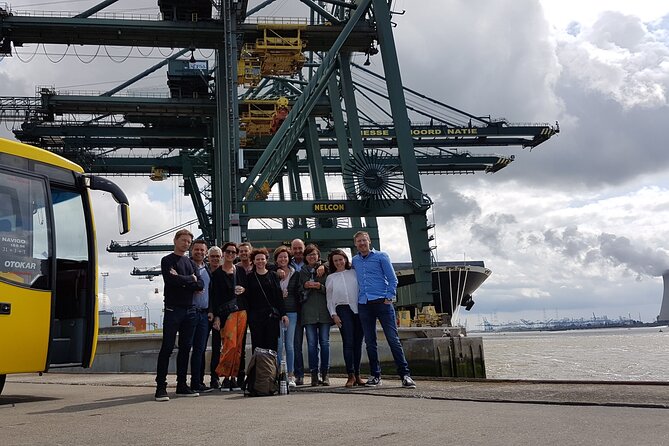
- Havenhuis and the dry docks: See Antwerp’s striking glass headquarters beside the old fire station and future maritime museum site.
- Europe-sized port in a private vehicle: Cover a huge industrial area in about two and a half hours with your own group of up to 15 people.
- Working locks up close: Watch tugboats, barges, and coastal freighters at the Boudewijn and Van Cauwelaert locks.
- Lillo’s old village beside modern industry: Walk among cobbled lanes, geese, old houses, and fortifications beneath refinery smokestacks.
- More than ships: The route explains container handling, chemical production, rail freight, fruit imports, and flood control.
- Personal guiding: Guides such as Laurens and Niki use stories and conversation rather than simply reciting dates and statistics.
Why Antwerp’s port needs a car tour
Antwerp’s port stretches far beyond the city’s familiar waterfront. Roads run between docks, pipelines, storage tanks, locks, rail lines, and terminals for many miles. From a normal city sightseeing route, you may see only a small slice of this operation.
A private car tour solves that problem. You remain in your vehicle for much of the route, getting out at selected viewpoints where the scale or setting deserves a closer look. That makes the experience practical in a place where distances are long and pedestrian access is limited.
The guide turns the drive into a moving explanation of how the port works. You hear how ships reach inland terminals, how locks manage different water levels, how containers move from vessel to rail, and how entire villages were altered or removed as the docks expanded.
This is not a polished tourist attraction with signs at every corner. It is a working industrial zone. That is the appeal, but it also means the experience depends on traffic, port activity, construction, and weather.
More guided excursions in Belgium:
- Private shore excursion from Zeebrugge to Bruges with driver and guide
★ 4.0 · 12 reviews - For cruise passengers: Guided ATV Tour of Dutch & French St. Maarten
★ 5.0 · 1,552 reviews - Civitavecchia Port: Private or Shared Guided Tour of Rome
★ 4.4 · 826 reviews
Havenhuis and the dry docks: Antwerp’s old and new face
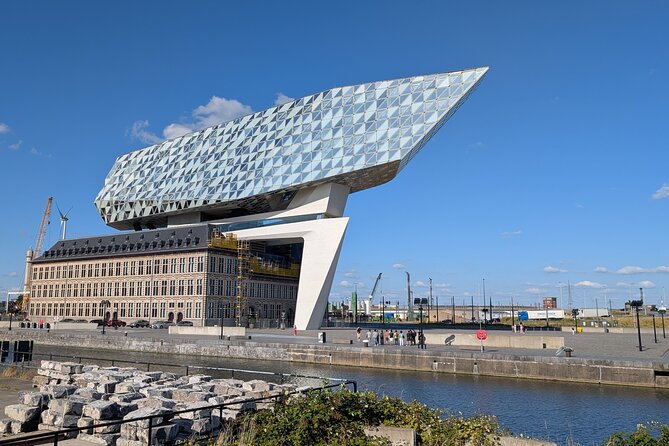
The tour begins near Kinepolis Antwerpen and heads toward Droogdokkenweg. One of the first major stops is the view across the water to Havenhuis, the port headquarters designed by Zaha Hadid.
The building’s glass upper section has a faceted, ship-like shape. It appears to float above a former fire station, creating a sharp contrast between modern architecture and industrial heritage. Your guide explains why the design looks as it does and places the building within Antwerp’s changing port district.
You also look toward the adjacent dry docks. These old granite basins are being transformed into a maritime museum, giving the area a second life. The stop lasts about 10 minutes and is free to enter, though the value here is the setting and the explanation rather than an indoor visit.
Bring a phone or camera if you enjoy architectural photographs. The water, dry docks, fire station, and glass structure make this one of the clearest visual moments of the route.
Oosterweel: a medieval church beside a giant construction site
The road then passes Oosterweel church, a small 15th-century building that seems almost out of place beside the port’s vast construction works.
That contrast is the point. Your guide connects the old river parish with the port’s post-war expansion and the current Oosterweel project. The construction yard is being used to cast tunnel sections for the long-awaited closure of Antwerp’s Ring road, and it is described as Europe’s largest wharf.
You will not spend a long time here. Instead, you get a quick lesson in how the port keeps changing. Medieval settlements, modern roads, tunnels, docks, and flood-control projects all occupy the same broad area.
This stop works best if you enjoy seeing infrastructure in progress. If you want a traditional monument visit, it may feel brief. If you want to understand why Antwerp’s roads and port are so closely linked, it adds useful context.
Scheldelaan: chemical plants on one side, public art on the other
Scheldelaan provides one of the tour’s clearest looks at Antwerp’s industrial muscle. On one side are storage tanks, cracking towers, pipelines, and steam rising from the chemical cluster. Antwerp is home to Europe’s second-largest chemical zone, and this road gives you a close view of its scale.
On the other side, a long flood wall carries the color and energy of an international graffiti contest. The contrast is striking: precision industrial equipment facing a public wall covered in large-scale artwork.
Your guide explains that pipelines run beneath the road like transport routes you cannot see. That detail helps you understand that the port is not just about ships and cranes. It is also a network for moving raw materials and finished products between plants, storage sites, docks, and inland markets.
This section is mainly viewed from the car. Keep your expectations realistic. You are not touring a chemical factory, and there is no promise of stopping wherever you wish. The strength is the running commentary and the unusual view from a public road.
More shore excursions in Belgium:
- Deluxe Bruges Shore Excursion from Zeebrugge Cruise Port
★ 4.5 · 80 reviews - Bruges Tour with Canal Cruise from Zeebrugge Cruise Port
★ 4.5 · 78 reviews - Best Bruges Shore Excursion – Small Group + Optional Canal Cruise
★ 4.5 · 62 reviews - Best Bruges Shore Excursion including Deluxe Canal Cruise
★ 4.0 · 27 reviews
Boudewijn and Van Cauwelaert locks: the port’s working rhythm
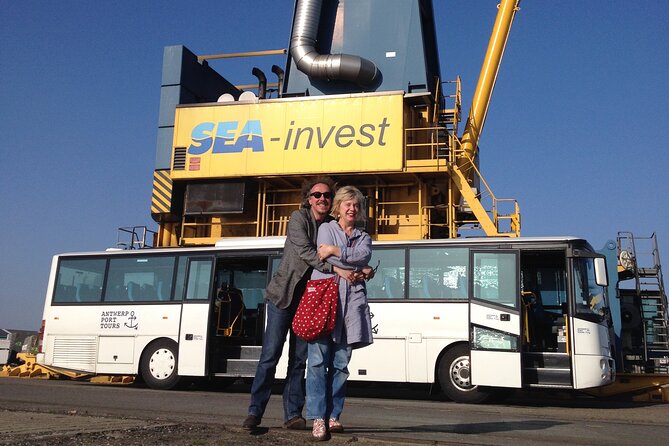
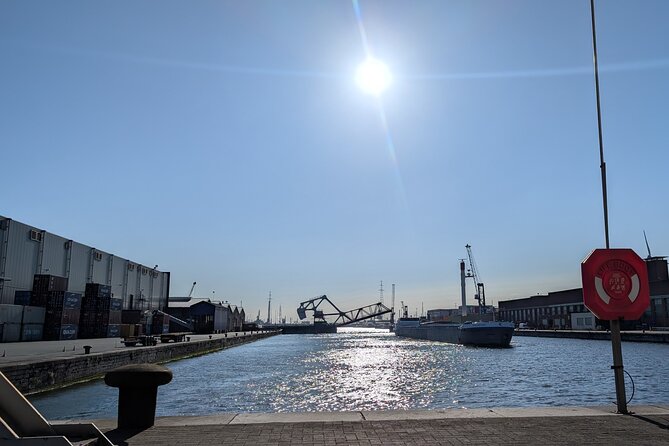
At Boudewijnsluis, you get out beside De Vaarkom basin for roughly 10 minutes. The twin Boudewijn and Van Cauwelaert locks are smaller than the port’s most famous gates, but they handle an essential share of barge and coastal traffic.
Here, you can watch the practical side of shipping. Your guide points out lock signals, explains how vessels are positioned, and draws attention to the water movement created by bow thrusters. Tugs and short-sea freighters make the process easy to follow because the vessels are close and the locks feel more contained.
I like this stop because it shows the port at human scale. A massive sea lock can be impressive, but a smaller lock often lets you understand the steps more clearly. You see why the gates matter to refinery deliveries and regional shipping.
Ship movements are never guaranteed, so patience helps. If nothing is passing during your visit, the guide still provides the working explanation, but the stop is most memorable when a tug is nudging a freighter into position.
Lillo windmill and the cost of port expansion
The route continues along Scheldelaan toward a lone brick windmill associated with the vanished village of Lillo. The windmill is viewed as a drive-by, with about 10 minutes set aside for the stop.
It is a small landmark with a large story. By this point, you have already traveled roughly 30 kilometers through port territory, yet you are only about halfway across its full reach. The windmill helps make that size visible.
Your guide explains how villages and hamlets were bought out or dismantled as docks pushed inland. The story is not only about construction and economic growth. It is also about people who lost homes, streets, churches, and familiar neighbors.
You may hear memories of residents who resisted leaving until the last possible moment. That personal angle keeps the port from becoming a collection of statistics. It reminds you that industrial expansion changes communities as well as shorelines.
Berendrecht Lock: a quick look at giant engineering
The Berendrecht Lock is one of the route’s major scale moments. The car passes along a service road beside the lock, offering a close view of a gateway built for very large ocean vessels.
Your guide explains the roles of tugboats, line handlers, and the lock itself. If a large bulk carrier or container ship is moving through, you may see a vessel roughly 300 meters long passing the guide rails. From road level, the hull can feel more like a wall than a boat.
This is a drive-by rather than a scheduled ship-spotting session. Port traffic changes constantly, so you may see a ship in motion or simply the lock’s enormous dimensions. Either way, it helps you grasp why locks are such an important part of Antwerp’s port system.
The stop is especially useful for families and first-time port visitors because the size is instantly clear. You do not need specialist knowledge to appreciate a lock that makes a giant vessel look surprisingly manageable.
Dock 910: four borders and systems in one view
At Zandvlietweg, the group gets out near PSA’s quays at Dock 910. The view brings several parts of the port together.
Container cranes work along the river. The Berendrecht and Zandvliet locks sit nearby. The Belgium-Netherlands border runs through the river, and the cooling towers of the Doel nuclear plant can be seen farther away.
This is one of the best stops for understanding the port as a connected system. In a single view, you can relate shipping, national borders, locks, energy production, and container logistics.
The terminal itself is active. Straddle carriers move containers around the quay while cranes transfer boxes between ships and shore. Your guide helps you follow the action instead of seeing only a jumble of steel and machinery.
You spend about 10 minutes here. That is enough for a clear look and explanation, though not enough for an extended photography session if several operations are happening at once.
Lillo Fort: old village life beside chemical giants
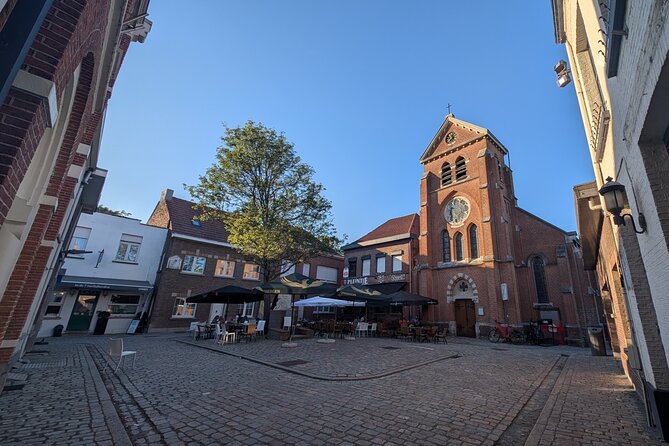
Lillo is the emotional center of the tour. After the huge locks and industrial roads, the car reaches the old fort and its cobbled lanes.
The setting changes quickly. You see grassy ramparts, old fishermen’s houses, a small dock, and geese around the village. Café smells and birdsong replace the noise of cranes and traffic. Yet the chemical complex remains close across the dike, making the contrast impossible to miss.
The guide brings in stories of Spanish sieges, smugglers, and the residents who kept their community alive despite the port’s expansion. The point is not to pretend that Lillo exists outside the modern port. It exists because the old and new have been forced into the same small space.
You have about 30 minutes here, the longest stop on the route. That gives you time to walk a little, take photographs, and let the setting change your sense of the port.
For me, this is the stop that makes the entire trip more than an industrial tour. You see what the port replaced, what it preserved, and how local identity can survive beside one of Europe’s biggest chemical zones.
Antwerp-North Hump Yard: the rail side of the port
The tour also shows how cargo leaves the docks. From the car, you look down toward Antwerp-North’s large marshalling yard, where as many as 1,000 rail wagons can be reshuffled in a day.
Your guide explains gravity shunting. Locomotives push mixed trains over a hump, wagons roll downhill, and sensors, retarders, and computer-controlled switches sort each wagon into a new train. The routes can lead toward Germany, France, or the Ruhr area.
This section completes the port story. Ships bring goods in, terminals handle them, and railways send them inland. Roads and waterways add two more links to the chain.
The process may be visible during your visit, but it is not guaranteed. Even without live shunting, the explanation gives you a useful picture of the port’s rail operation. This is another drive-by, so you should be ready to watch from the vehicle rather than explore the yard on foot.
Container Canyon and the fruit terminal
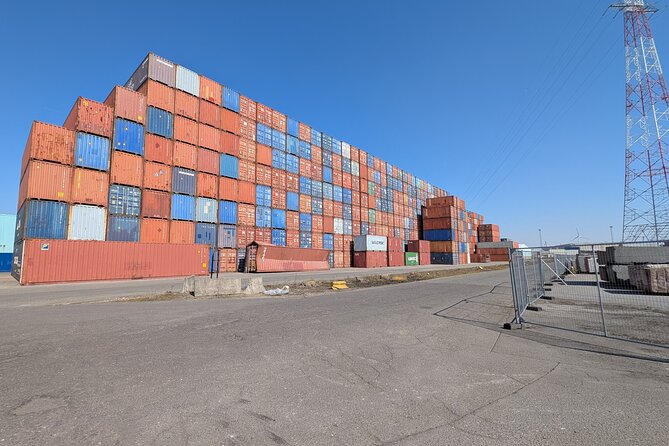
Near Lubeckweg, the car enters a maze of container stacks. The boxes form narrow corridors, and you may be close enough to read their identification marks.
The route also passes large granite blocks waiting for export and refrigerated container racks serving Europe’s largest fruit terminal. Bananas and citrus can move from ship to supermarket in a short period, and the refrigerated units help keep that supply chain working.
This final stretch is a fast burst of port activity. It can feel less scenic than Lillo or Havenhuis, but it gives you a close look at the practical details of global trade. You see the containers, cooling equipment, stone, roadways, and storage spaces that make the port function after a ship leaves the quay.
The stop lasts about five minutes, so do not plan on a long walk. Think of it as a final moving picture of the port’s daily work.
Price, vehicle needs, and group value
The price is $314.42 per group of up to 15 people. That is not a cheap individual ticket, but the calculation changes if you fill the vehicle. A group of 10 pays much less per person than a couple booking alone.
The price includes gratuities, and the tour is private. That matters if you want to ask questions, pause for photographs, or keep the discussion suited to children, family members, or colleagues.
You must supply the car or minibus. The guide boards your vehicle, so check that your group has enough seats and that the driver is comfortable with a long route through a large industrial area. A coach or minibus is not included.
The experience lasts about two hours and 30 minutes. Much of that time is spent driving, with short stops at the main viewpoints and a longer visit at Lillo Fort. If you want a full day of walking, this is not the right format. If you want a broad introduction to a huge port without arranging several separate visits, the private rate can make sense.
Who should book this Antwerp port tour?
I would choose this experience if you are curious about shipping, engineering, industry, urban change, or the less polished side of a destination. It is also a strong choice for families with older children, since the moving vehicles and giant machinery give younger visitors something concrete to watch.
The advised minimum age is 12. Most people can participate, but the tour is not recommended for anyone with serious respiratory diseases. Service animals are allowed, and the route is near public transportation, though your own vehicle is still required for the tour itself.
The guides add a personal element. Laurens is described as speaking with passion about Antwerp and its port, while Niki offers more than 40 years of maritime experience and can guide in several languages, including Luxembourgish. The supplied tour language is English, so confirm language needs when booking.
The tour runs in good weather. You can cancel up to 24 hours before the start for a full refund, while poor weather may lead to a new date or a full refund.
Should you book it?
Book this tour if you want to understand how Antwerp works beyond its historic center. You will see architecture, old villages, locks, ships, chemicals, rail freight, containers, and fruit distribution in one compact route.
Skip it if you want a relaxed walking tour, a guaranteed close-up of a particular ship, or a conventional museum visit. The strongest parts depend on what is moving that day, and several stops are short.
For a group with its own car or minibus, the private format offers a practical way to grasp Antwerp’s enormous port. The best reason to go is not any single crane or lock. It is the unusual combination of medieval Lillo, modern Havenhuis, giant infrastructure, and working industry all occupying the same stretch of northern Belgium.
FAQ
Where does the Antwerp Port Tour start?
The tour starts at Kinepolis Antwerpen, Groenendaallaan 394, 2030 Antwerpen, Belgium.
Where does the tour end?
The activity ends back at the starting meeting point.
How long does the tour last?
The tour lasts approximately two hours and 30 minutes.
How many people can join one booking?
The private tour accommodates up to 15 people per group.
Is transportation included?
No. You must provide the car or minibus. The guide boards your vehicle during the tour.
What language is offered?
The tour is offered in English.
Is this a private tour?
Yes. Only your group participates.
Can I cancel for a full refund?
Yes. You must cancel at least 24 hours before the local start time for a full refund. Changes or cancellations made less than 24 hours before the start are not accepted for a refund. If poor weather cancels the experience, you will be offered another date or a full refund.
Newly added around Belgium
- From Zeebrugge: Private Bruges with Canal Boat Shore Excursion★ 5.0 · 5 reviews
- 6 Hour Bruges Shore Excursion from Zeebrugge Cruise Port★ 4.5 · 23 reviews
- Private shore excursion from Zeebrugge to Bruges with driver and guide★ 4.0 · 12 reviews
- Bruges Tour from Your Cruise Ship with Canal Cruse & Leisure Time★ 5.0 · 6 reviews
- Bruges Delights – Best Tour Designed for Cruise Passengers★ 5.0 · 9 reviews
- Bruges Tour from Cruise Port and Venice of the North Canal Cruise★ 5.0 · 2 reviews
- Deluxe Bruges Excursion and Canal Cruise from Cruise Terminal★ 4.5 · 23 reviews
- Best Bruges Shore Excursion from Your Ship with Canal Cruise★ 4.5 · 14 reviews
Shore Excursions, compared.
FOR CRUISERS: Skip The Lines PRIVATE EPHESUS TOUR &On Time Return
Read our review →
Top Choice For Cruisers: Ephesus, Mary’s House WITH TICKETS+LUNCH
Read our review →
PRIVATE EPHESUS TOUR FOR CRUISERS: On-time Return and Skip-Line
Read our review →
Timanfaya and Green Lagoon for Cruise Passengers
Read our review →
For cruise passengers: Guided ATV Tour of Dutch & French St. Maarten
Read our review →
PRIVATE TOUR FOR CRUISERS: Mary’s House (Meryemana) and Ephesus
Read our review →
Browse the lists this tour appears in