REVIEW · KUSADASI SHORE EXCURSIONS
NEW: Private The Most Detailed Ephesus Shore Excursion / with Lunch
Ephesus is far more than a quick photo stop at the Library of Celsus. This private tour takes you through the city’s main streets and public buildings, then adds the Terrace Houses, St. John’s Basilica, and the Temple of Artemis. You get a useful look at daily Roman life, politics, religion, and early Christianity.
I like the private format because your guide can adjust the pace and explain what interests you most. I also like the included Turkish lunch and Mercedes van, which make a long day easier. The catch is the price of admission: the listed tour fare is $79.20, but several major sites require separate payment.
Key points to know before you book
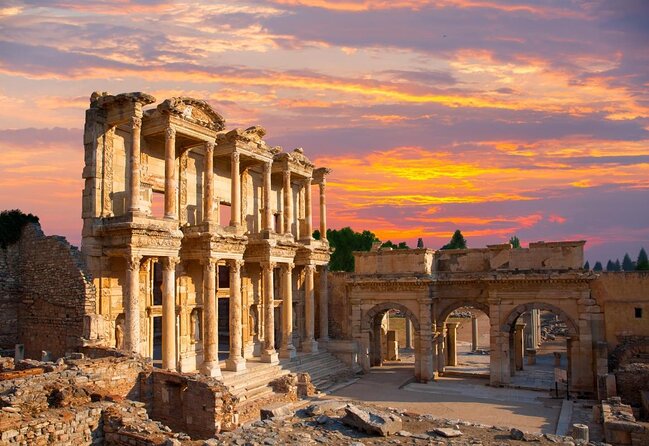
- The route goes beyond the famous library: You see the Odeon, State Agora, temples, baths, fountains, gates, and civic buildings often skipped on shorter visits.
- The Terrace Houses cost extra: Their mosaics and wall paintings are among the most rewarding parts of Ephesus, but admission is separate.
- Your guide shapes the day: Selin, Nesli, Ahmet, Asli, Özgür, Mary, Mehmet, Tas, and others have been praised for clear explanations and flexible pacing.
- Lunch is included, drinks are not: Expect a filling Turkish meal, with beverages paid separately.
- Allow seven hours if you can: The route is broad, and rushing through Ephesus would undercut the main reason to choose this tour.
- Cruise passengers need to watch the clock: One party returned late to the ship, so ask your guide to confirm the return time early.
Why this private Ephesus route is different
Many Ephesus visits focus on the Library of Celsus, the Great Theatre, and Curetes Street. Those are essential, but this route gives you a fuller picture of the ancient city.
You also visit the State Agora, Odeon, Temple of Domitian, Hercules Gate, Temple of Hadrian, Terrace Houses, Temple of Artemis, and Basilica of St. John. That wider route helps you see Ephesus as a working city, not just a collection of impressive ruins.
The private setup matters here. Ephesus can feel like a lot to absorb. You have a guide beside you to explain why one building was used for government, another for concerts, and another for imperial worship. You can ask questions without waiting for a large group to catch up.
The tour is offered in English and uses an air-conditioned Mercedes van. Pickup is available from the Kusadasi cruise port, hotels, and the domestic airport. For cruise passengers, the meeting point is the exit gate of the immigration terminal, where the guide waits with an OTTI Travel sign.
More Private Shore Excursions in Kusadasi
- FOR CRUISERS: Skip The Lines PRIVATE EPHESUS TOUR &On Time Return
★ 5.0 · 8,527 reviews - PRIVATE EPHESUS TOUR FOR CRUISERS: On-time Return and Skip-Line
★ 5.0 · 5,807 reviews - PRIVATE TOUR FOR CRUISERS: Mary’s House (Meryemana) and Ephesus
★ 5.0 · 1,349 reviews
Starting at Mary’s House
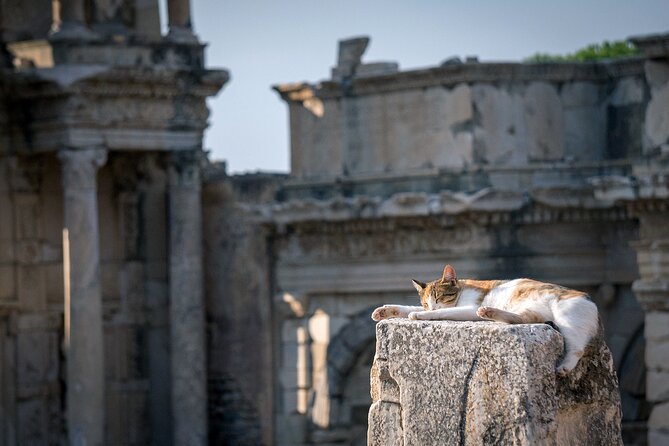
The first stop is Meryemana, known as the House of the Virgin Mary. You spend about 30 minutes here, and the admission fee is not included.
This is a quiet religious site above Ephesus, and it gives the day a different opening from the marble streets below. The visit is short, so you should not expect a long guided program. It works best as a calm introduction before the much larger ancient city.
The site is especially relevant if Christian history matters to you. The tour later continues to St. John’s Basilica, so these two stops provide a useful religious thread through the day.
If you prefer archaeology over sacred sites, tell your guide. Since this is private, the timing can be adjusted within reason. The important point is that Meryemana adds another admission charge, listed as €18 per person.
Entering Ephesus through its public heart
You spend about two hours in the Ancient City of Ephesus, though the complete route includes several timed stops within the site. The visit covers Harbour Street, Marble Street, the Commercial Agora, latrinas, baths, fountains, temples, gates, and government buildings.
The State Agora is one of the more revealing stops. Built in the first century BC, it was used for civic business and government discussions rather than everyday shopping. That detail changes how you read the open space. Ephesus was not only a port and commercial center. It was also a place where public decisions were made.
Archaeology at the State Agora reaches further back than the Roman city you see above ground. Excavations found graves from the seventh and sixth centuries BC, along with an archaic terracotta sarcophagus. The area had once served as a cemetery before becoming part of the city.
You also hear about the water system. A reservoir at the agora received water through the Pollio Aqueduct, whose remains can still be seen along the road between Selçuk and Aydin. Details like this make the ruins easier to understand. A fountain was not just decoration. Water supply helped the city function.
The Odeon and the business of government
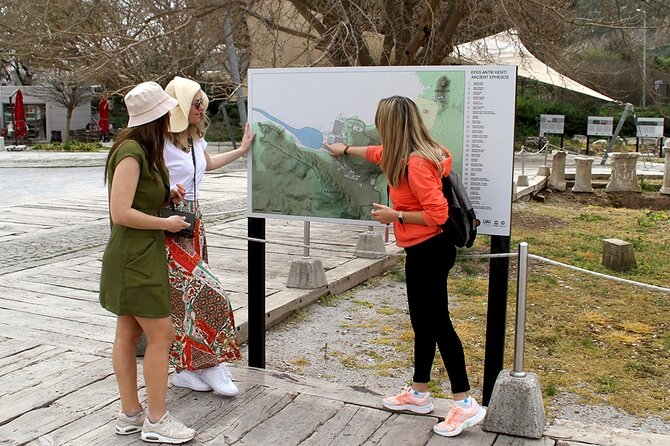
The Odeon is a small theater with a capacity of about 1,500 people. It served two jobs: a concert hall and a meeting place for the Boule, or city council.
That dual purpose is one of the best examples of how public buildings worked in Ephesus. The larger Great Theatre could host events open to the public, while the Odeon offered a more controlled setting for the city’s governing body.
The building dates to the second century AD and was funded by Publius Vedius Antonius and his wife, Flavia Paiana. You can still make out the seating, orchestra, stage area, and restored sections. The original building had a wooden roof, a practical feature that is easy to miss unless your guide points it out.
This is a good place to ask how Ephesus was governed. The tour explains the difference between the public assembly and the smaller council. That civic context gives the monuments more meaning than a simple list of dates.
More Private Shore Excursions in Turkey
- Ephesus Small Group – Semi Private Shore Excursion
★ 5.0 · 406 reviews - 3-Hour Private Ephesus, Terrace Houses, Cruiser Only
★ 5.0 · 274 reviews - From Kusadasi: Private Ephesus Tour for Cruise Passengers
★ 4.8 · 252 reviews - ALL INCLUSIVE Private Ephesus, Terrace Houses tour with LUNCH
★ 5.0 · 203 reviews
Temples, emperors, and the Hercules Gate
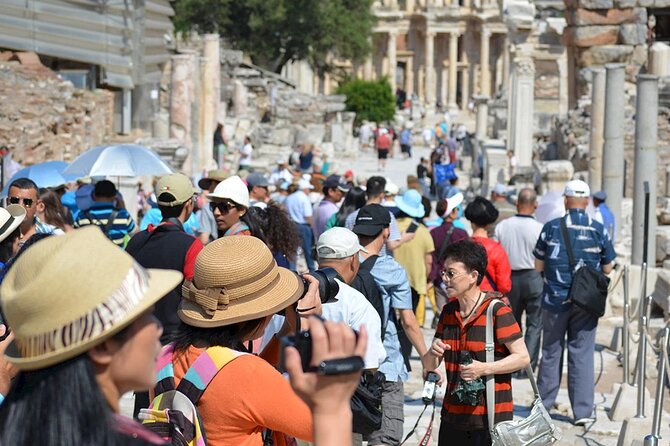
The Temple of Domitian occupies a large terrace at the southern end of Domitian Street. It is considered the first known Ephesus temple dedicated to an emperor.
The temple’s size and position reflect the importance of imperial worship. Ephesus received permission to become a neokoros, an honor tied to maintaining an emperor temple. You see the broad terrace and remaining stairs, while the original altar is now in the Izmir Museum.
The stop is brief, about 15 minutes, but it raises a useful question: how did cities show loyalty to Rome? Your guide can connect the temple to the political pressures and honors of the Roman period.
Further along Curetes Street is Hercules Gate. Only the two sides remain, but the reliefs of Hercules explain the name. The gate was moved to its current position in the fourth century AD, while the reliefs date to the second century.
The gate also tells you something about changing city life. Its narrow opening prevented wheeled vehicles from passing. By the fourth century, Curetes Street had become a pedestrian area. That is a small detail, but it lets you picture people walking the street rather than imagining constant cart traffic.
Hadrian’s Temple and the Terrace Houses
Hadrian’s Temple is one of the best-preserved structures on Curetes Street. Its four Corinthian columns support a curved arch with a relief of Tyche, the goddess of victory.
The temple was built before AD 138 and honored Emperor Hadrian after his visit to Ephesus. The bases in front once held statues of four later emperors: Diocletian, Maximian, Constantius I, and Galerius.
You get roughly 10 minutes here, enough to see the facade and hear the story behind the building. It is also one of the most photogenic stops, but your guide can help you look beyond the columns and notice the later additions.
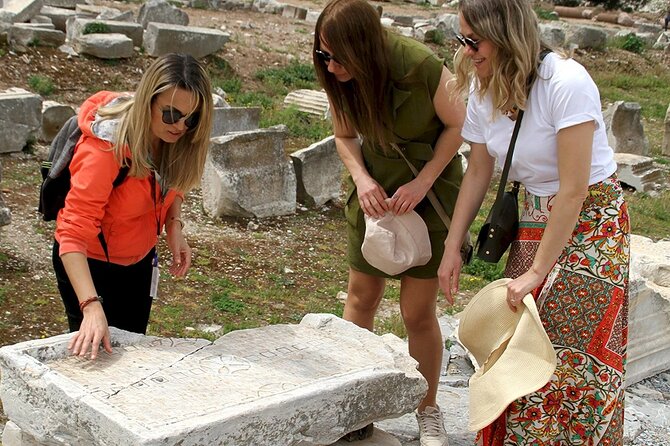
Across from the temple are the Terrace Houses, also called the homes of wealthy Romans. This is one of the most worthwhile optional additions on the route, especially if you want to understand private life rather than public monuments.
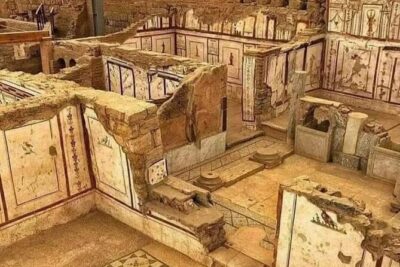
The homes date from the first century BC and remained in use until the seventh century AD. Two houses are open as a museum beneath a protective roof. You see floor mosaics, wall paintings, courtyards, and domestic rooms.
Admission costs €15 per person. You will encounter stairs, and the site is not a quick flat walk. Still, I would pay for this addition if you care about Roman interiors. The public monuments show power. The Terrace Houses show how wealthy families lived.
The Library of Celsus and the Great Theatre
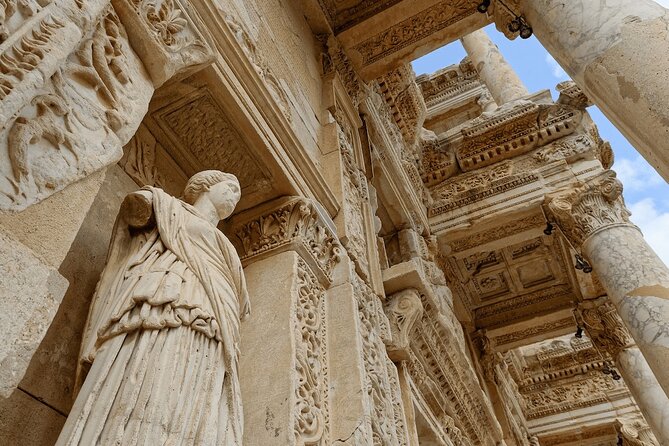
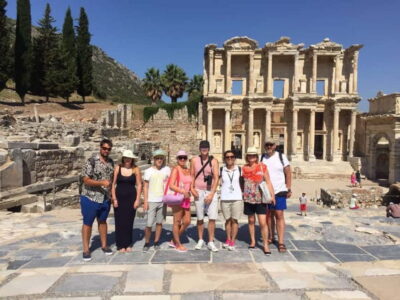
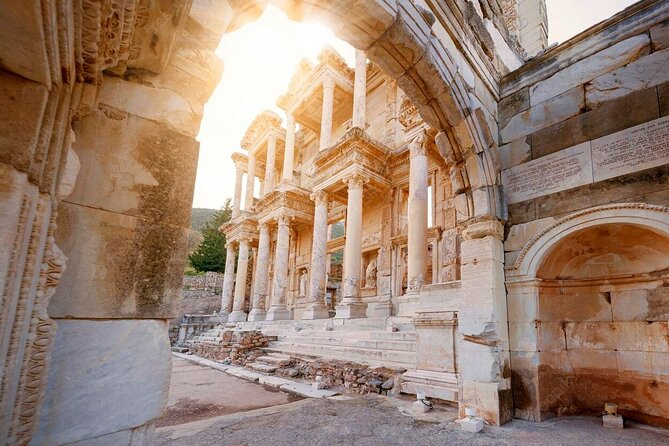
The Library of Celsus is the visual centerpiece of Ephesus. Built in AD 117, it was also a monumental tomb for Gaius Julius Celsus Polemaeanus, governor of the province of Asia.
His burial chamber was beneath the ground floor. The library held more than 12,000 scrolls, stored in wall niches with double walls designed to protect them from heat and damp. The building was both a memorial and a serious center of learning.
Take time to look at the facade, but listen closely to the explanation of its original use. It was not simply a grand library. It honored a powerful Roman official and linked memory, education, and public display.
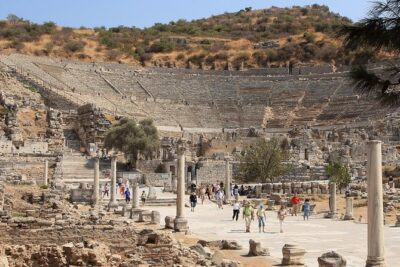
The Great Theatre is larger and more dramatic. Built first in the Hellenistic period and later expanded by the Romans, it held about 25,000 people. Its seating is arranged in 66 rows and divided by walkways into three sections.
The theater hosted concerts and plays, but also political and religious gatherings, philosophical discussions, gladiator contests, and animal fights. It faces Harbour Street, making it one of the first major structures you may notice when entering from the southern route.
Admission to the ancient city is listed at €40 per person. The theater itself is included in that site ticket, but the overall Ephesus admission remains a substantial extra cost.
The Temple of Artemis and St. John’s Basilica
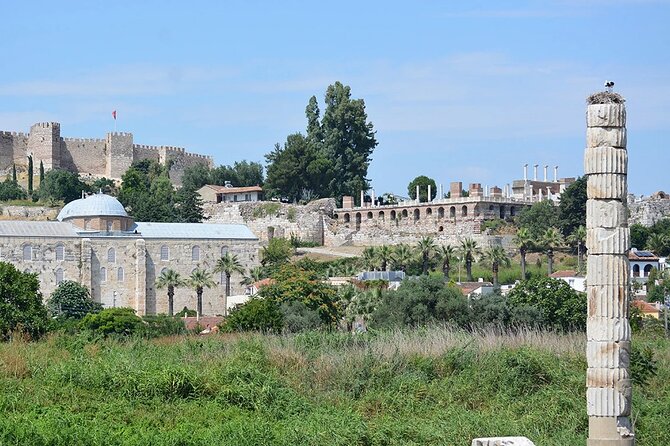
The Temple of Artemis was one of the Seven Wonders of the ancient world. Today, only foundations and a reconstructed column remain at the original site.
It can feel underwhelming if you arrive expecting a complete temple. The best way to appreciate it is to understand the gap between what you see and what once stood there. The temple was made of marble, and some of its finest surviving pieces are now in the British Museum in London.
The stop takes about 40 minutes. It is worth keeping if ancient wonders and Greek religion interest you, but it may not be the priority for someone who wants every possible minute inside Ephesus.
The Basilica of St. John offers a stronger sense of place. Tradition holds that the apostle spent his final years near Ephesus and was buried on Ayosolug Hill. A small chapel was built over the grave in the fourth century, then replaced by a large basilica under Emperor Justinian in the sixth century.
The site connects the ancient city with early Christianity. According to tradition, John came to Ephesus with Mary, wrote his Gospel there, and wrote Revelation on Patmos. Admission is listed at €6 per person.
Lunch, transport, and the shopping question
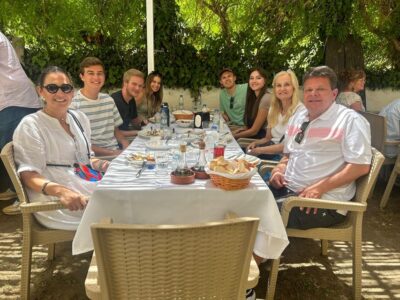
Lunch is included at a local restaurant, and the food is described as plentiful. Drinks are extra. One useful detail from the tour experience is the fresh local produce, including figs and pomegranate juice. Turkish olive oil and pomegranate dressing also earned special praise.
The air-conditioned Mercedes van is a real benefit in warm weather. After several hours among exposed stone streets, a clean vehicle and a safe driver make the return journey much more comfortable.
Some versions of the day include a rug-making stop after lunch. You can learn how Turkish rugs are produced, but the visit may shift into a sales presentation. The rugs are handmade and costly, and staff may show several pieces even if you are not shopping.
I would treat this as optional time, not a central reason to book. If you dislike commercial stops, say so clearly at the start. The private format gives you a better chance of keeping the focus on Ephesus.
Price, timing, and who gets the best value
The tour costs $79.20 per person, which is a strong starting price for a private guide, private vehicle, hotel or port pickup, parking, and lunch. But you need to budget for admission separately.
The listed entrance fees are:
- Ephesus Ancient City: €40 per person
- House of the Virgin Mary: €18 per person
- Terrace Houses: €15 per person
- Basilica of St. John: €6 per person
That adds €79 per person if you visit every separately charged site. Drinks at lunch are also extra. The total cost is therefore much higher than the headline tour fare, though the private service and broad route may still offer good value for a family or small group.
The advertised duration is 5 to 7 hours. I would plan around the longer end, especially if you want the Terrace Houses, lunch, and all the stops. Cruise passengers should provide ship details, docking time, disembarkation time, and re-boarding time when booking.
One group returned late to its ship, even though the cruise line delayed departure. That is not a reason to reject the tour, but it is a reason to confirm the return plan early and avoid adding unplanned shopping time.
Which guide might suit your group?
The guide can make or break a historical site, and this tour has received particularly strong praise for its personal approach.
Selin is praised for answering questions and adjusting the day to suit the group. Nesli is described as especially strong on the history and fun to spend time with. Ahmet earned praise for helpful, courteous service, while Asli was compared to a friend showing the city around.
Özgür, also called Oscar, is a good name to request if you want a flexible guide who matches the route to your interests. Mary received strong praise from a family with teenagers, and Tas worked well with adults and children aged 13 and 7.
Guide assignments cannot be guaranteed from the information provided, but you can ask for a preferred guide when booking. The repeated theme is clear: the best part of this private tour is the human explanation, not simply the van or the admission arrangement.
Should you book this Ephesus excursion?
Book it if you want a private, full-day-style look at Ephesus rather than a quick highlights tour. It suits families, couples, cruise passengers, and anyone who wants the freedom to ask questions or adjust the pace.
The strongest reasons are the wide route, private vehicle, included lunch, and access to guides such as Selin, Nesli, Ahmet, Asli, Özgür, Mary, and Tas. The Terrace Houses are especially worthwhile if Roman home life interests you.
Think twice if your budget is tight, because admissions can add €79 per person. Also reconsider if you dislike rug demonstrations or prefer a short visit focused only on the Library and theater.
For most people with one day in Kusadasi, I would choose this tour, pay for the Terrace Houses, and tell the guide exactly how much time you have before the return to the port. That small bit of planning can turn a long archaeological visit into a relaxed and memorable day.
FAQ
How long does the private Ephesus tour last?
The tour lasts approximately 5 to 7 hours. The longer timing is useful if you want to visit the major ruins, Terrace Houses, lunch, and the religious sites without rushing.
Is lunch included?
Yes. Lunch at a local restaurant is included. Drinks are not included and must be paid for separately.
Are entrance fees included in the tour price?
No. Ephesus, the House of the Virgin Mary, the Terrace Houses, and St. John’s Basilica each have separate admission fees. The Great Theatre is included within the Ephesus Ancient City admission.
Where is cruise port pickup?
Cruise passengers meet the guide at the exit gate of the immigration terminal at the Kusadasi cruise port. The guide holds a board with an OTTI Travel sign.
Is this a private tour?
Yes. Only your own group participates, and the itinerary can be customized to your preferences.
Can I cancel the booking?
You can cancel up to 24 hours before the experience start time for a full refund. Cancellations or changes made less than 24 hours in advance are not accepted for a refund.
More Shore Excursions with Lunch in Turkey
- Ephesus Tour For Cruisers from kusadasi with Lunch(skip the line)
★ 5.0 · 36 reviews - Kusadasi: Private Ephesus Tour with Lunch for Cruisers
★ 4.7 · 36 reviews - SKIP-THE-LINE: BEST OF EPHESUS PRIVATE TOUR with Lunch & ENTRY
★ 4.5 · 22 reviews - Private Ephesus skip line Tour Lunch inc only for cruisers
★ 5.0 · 20 reviews
More Shore Excursions with Lunch in Kusadasi
- Top Choice For Cruisers: Ephesus, Mary’s House WITH TICKETS+LUNCH
★ 5.0 · 7,233 reviews - ALL INCLUSIVE VIP Shore Excursion Customizable Ephesus with Lunch
★ 5.0 · 361 reviews - Kusadasi Shore Excursion: Ephesus Sightseeing Tour with Lunch
★ 4.5 · 145 reviews - FOR CRUISERS: PRIVATE EPHESUS TOUR INCLUDES ENTRY FEES & Lunch
★ 5.0 · 40 reviews
Newly added around Kusadasi
- Ephesus Shore Excursions For Cruisers★ 5.0 · 3 reviews
- The Best of Ephesus Tour For Cruisers★ 4.0 · 3 reviews
- Small Group Ephesus Shore Excursion from Kusadasi Port★ 5.0 · 4 reviews
- FOR CRUISERS: Best of Ephesus Tour with GUARANTEED ON-TIME RETURN★ 5.0 · 3 reviews
- BEST SELLER EPHESUS TOUR FOR CRUISERS Skip Line and OnTime Return★ 5.0 · 9 reviews
- FOR CRUISERS: Best Seller of Ephesus Private Tour by Locals★ 5.0 · 5 reviews
- FOR CRUISERS: Private Ephesus Ancient City & Ephesus Museum Tour★ 5.0 · 27 reviews
- Shore Excursions: Half Day Ephesus & Şirince Village Tour★ 5.0 · 4 reviews
Kusadasi Shore Excursions, compared.
FOR CRUISERS: Skip The Lines PRIVATE EPHESUS TOUR &On Time Return
Read our review →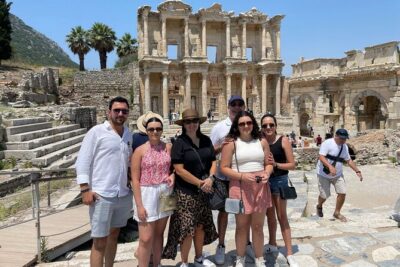
Top Choice For Cruisers: Ephesus, Mary’s House WITH TICKETS+LUNCH
Read our review →
PRIVATE EPHESUS TOUR FOR CRUISERS: On-time Return and Skip-Line
Read our review →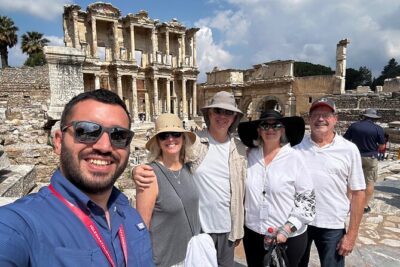
ALL INCLUDED: Ephesus Ruins, Mary’s House Tour incl ENTRY TICKETS
Read our review →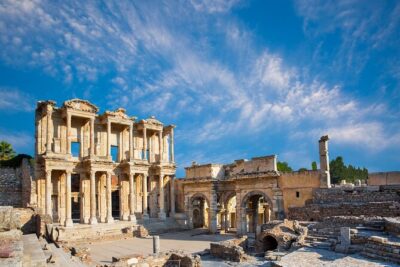
PRIVATE TOUR FOR CRUISERS: Mary’s House (Meryemana) and Ephesus
Read our review →