
REVIEW · SPAIN SHORE EXCURSIONS
Private 4-hour Shore Excursion of Cartagena with driver and official guide
Cartagena’s story comes in layers: Carthaginian walls, Roman ruins, medieval fortifications, and grand modernist buildings all sit within a compact Spanish port city. This private four-hour tour gives you a useful overview, with the Roman Theater Museum as its centerpiece and the hilltop Castillo de la Concepción supplying broad views over the city and harbor. I especially like the private vehicle and official guide, since you can avoid the logistics of a large group and keep the visit focused.
I also like the mix of sites: you get Roman archaeology, naval history, underwater treasure, and the city’s striking civic architecture in one outing. The main caution is price. At $487 per person, this is a costly half-day, and several entrance fees are extra. English ability can also vary by guide and driver, so clear confirmation before departure is sensible.
Key points at a glance
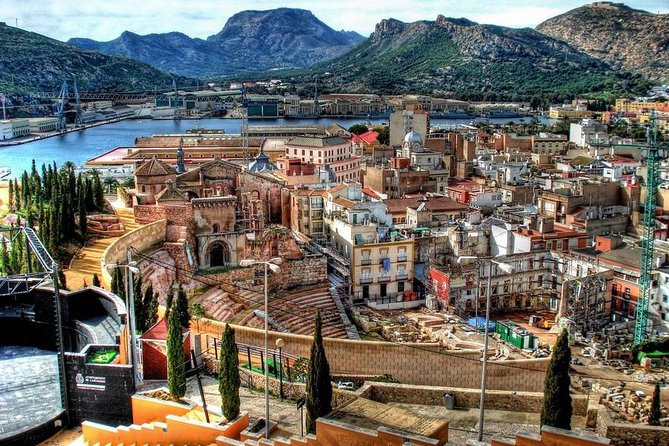
- The Roman Theater Museum is the tour’s anchor, with a carefully designed route leading into a theater built between 5 and 1 BC.
- A private car makes the four-hour schedule workable, especially when combining hilltop views with sites in the old center and port area.
- The Punic Wall connects Cartagena to Carthage, while the nearby crypt adds a later religious and artistic layer.
- ARQUA holds the Odyssey treasure, a huge collection of gold and silver coins recovered from the frigate Nuestra Señora de las Mercedes.
- Guide David has been praised for warm, entertaining explanations, though English fluency has not been equally strong with every guide.
- The price makes most sense for a small private group, particularly when convenience and a tailored pace matter more than saving money.
Why Cartagena works so well in four hours
Cartagena is unusually rewarding for a short port stop because important sights cluster around the historic center, the surrounding hills, and the waterfront. You can move from a Roman theater to a Carthaginian wall, then from a naval collection to a modern museum built around underwater archaeology.
The tour is private, so your group has the guide’s attention rather than a fixed script delivered to a crowd. That matters at archaeological sites, where the difference between seeing old stones and understanding a city can come down to a few good explanations.
Your pickup can be arranged at the Cartagena cruise port, your hotel, or another location in the city. A private vehicle and driver are included for four hours, while the guide stays with your group for the same period. The arrangement is best viewed as a guided overview rather than a slow, museum-by-museum study.
The stated stops include about 200 minutes of visits, before allowing for driving, elevator access, and movement between sites. That leaves little room for long pauses. If you want to spend serious time reading every museum panel, you may need to choose fewer stops.
More Private Shore Excursions in Spain
- Private Excursions For Cruise Ship Passengers
★ 4.5 · 110 reviews - Palma de Mallorca Shore Excursion: Private Tour of Valldemossa, Soller and Serra de Tramuntana
★ 5.0 · 65 reviews - Private Shore Excursion to Valldemossa and Palma de Mallorca
★ 4.5 · 43 reviews
Starting with the sea at the Naval Museum
The Museo Naval introduces Cartagena through Spain’s maritime past. Its subjects include the Spanish Navy, shipbuilding, nautical science, cartography, navigation instruments, maritime voyages, underwater archaeology, and less tangible seafaring traditions.
I like this as an opening stop because it gives context to Cartagena’s port. You are not simply looking at an old harbor and a collection of ships or objects. You are seeing how navigation, naval power, mapping, and shipbuilding shaped the city’s place on the Mediterranean.
The visit is allocated about 40 minutes, and admission is included at no extra cost. That is enough for a focused introduction, but not enough for a museum enthusiast to examine every section in detail. Ask your guide to point out the displays that best connect with the rest of the day, particularly the later visit to ARQUA.
Castillo de la Concepción and the best city view
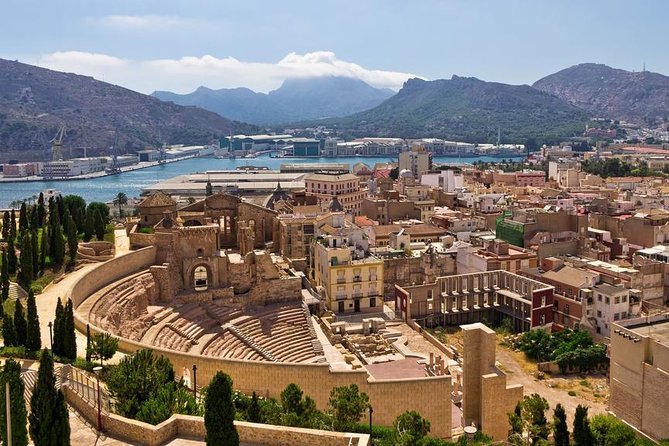
The next stop takes you up toward Torres Park by panoramic elevator, with an exterior look at the Castle of the Conception. The castle occupies one of Cartagena’s historic hills, and the height gives you a useful view over the city.
The fortification dates from the 13th or 14th century, though it was built over earlier Roman and Arab remains. A surviving Arab-period lantern served as a lighthouse, a small detail that helps explain why this hill mattered long before it became a medieval castle site.
The scheduled stop lasts about 20 minutes. That is enough for the elevator, the view, and an exterior explanation, but not an extended castle visit. Admission to the castle is not included, so confirm with the operator exactly what your planned visit covers if entering the interior matters to you.
For a port call, I think this brief viewpoint stop is smart. It helps you understand Cartagena’s layout before you walk through its old center. You see the relationship between the hills, the historic core, and the waterfront in a way that a street-level tour cannot provide.
Entering the Roman Theater Museum
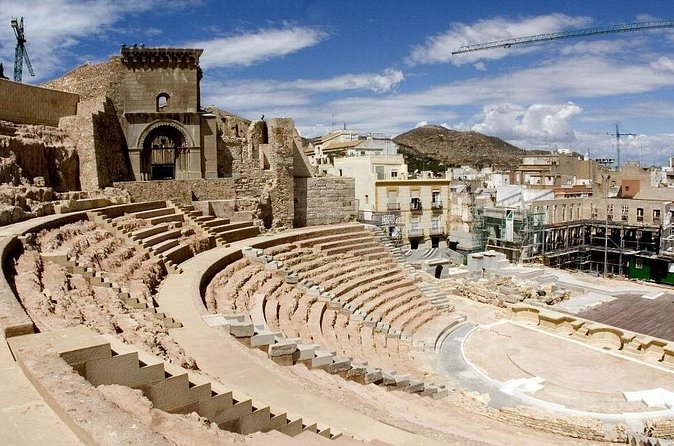
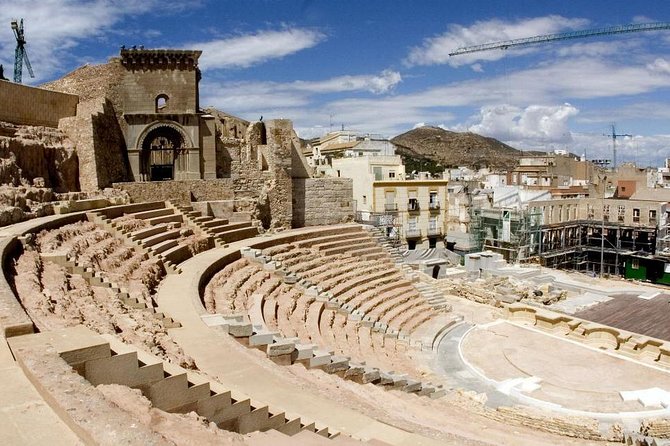
The Roman Theater is the strongest archaeological stop on the route. Built between 5 and 1 BC, it could hold about 7,000 spectators and remained in use until the third century. Later buildings covered much of the site, and the theater was not excavated until 1988.
The museum, designed by architect Rafael Moneo, leads you through the history of the site before bringing you into the monument itself. That design matters. Instead of approaching a ruin with little sense of place, you move through an interpretive route that turns the theater into the final room of the museum.
You have about 40 minutes here, and admission is included. The time is fairly tight, but the site is substantial enough to make this the part of the tour you should protect if the schedule slips.
The theater’s size is the striking fact. A capacity of roughly 7,000 people tells you that Roman Carthago Nova was not a minor outpost. It was a major urban center with the money, population, and civic ambition to build a large performance space.
Guide David has been praised for making this kind of history warm and entertaining rather than dry. One description of his tour highlights an in-depth visit to the theater museum after a short scenic drive. Another notes that he kept a group of retirees at a comfortable pace. If David is assigned to your group, his style appears well suited to visitors who want explanation without a rushed lecture.
Same port call, a different plan:
- Arrecife: Timanfaya and Green Lagoon for Cruise Passengers
★ 4.6 · 2,010 reviews - Timanfaya And El Golfo For Cruise Passengers (Mornings)
★ 4.5 · 944 reviews - Lanzarote: Day Tour for Cruise Passengers
★ 4.7 · 860 reviews - Fuerteventura: Corralejo Sand Dunes Guided Shore Excursion
★ 4.6 · 335 reviews
Modernist Cartagena around the old center
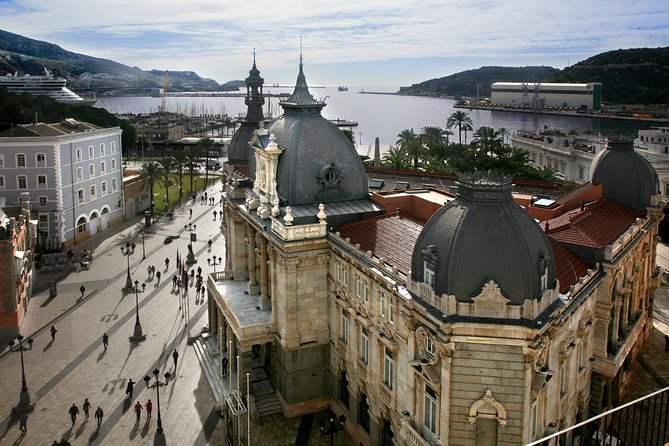
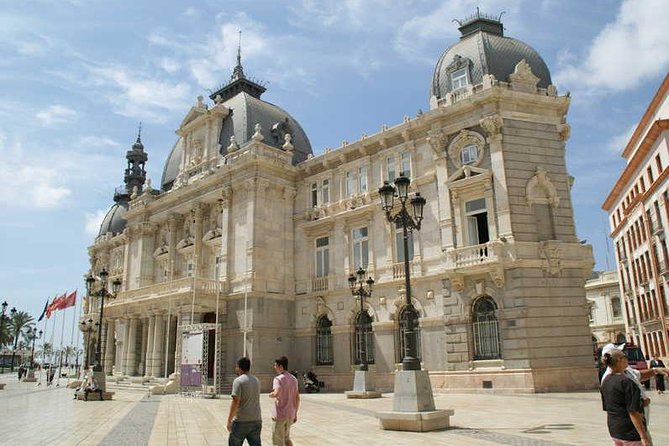
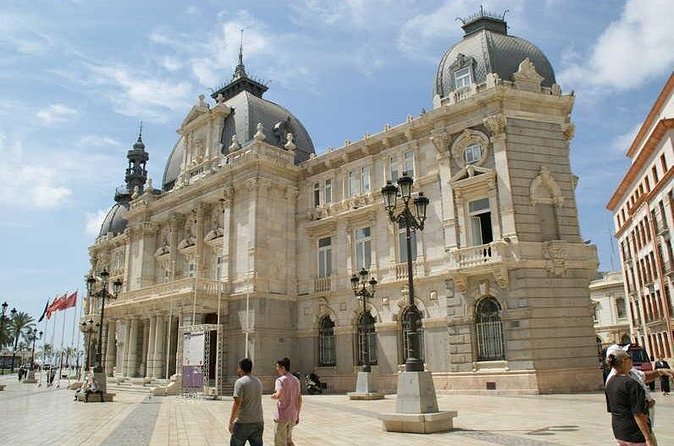
The route also passes the Consistorial Palace, or Cartagena City Hall. Built between 1900 and 1907, this triangular modernist building uses white marble on its facade and zinc domes on the roof.
Look for the repeated city symbols, especially the Castle of the Conception and the mural crown. The crown refers to an honor linked with the Roman general Scipio Africanus, who captured the city of Carthago Nova.
Another stop is an impressive 18th-century building on the main pedestrian street of the old center. The supplied details do not identify the building by name, so treat this as a brief architectural sight rather than a separate museum visit. Together, these city-center stops add a useful change of pace after the theater and before the archaeological parks.
The city’s architecture is one reason a private walking tour can work well here. You are not confined to ancient ruins. Cartagena’s streets show how later generations reused, reshaped, and celebrated the older city.
Reading Roman Carthago Nova at Molinete
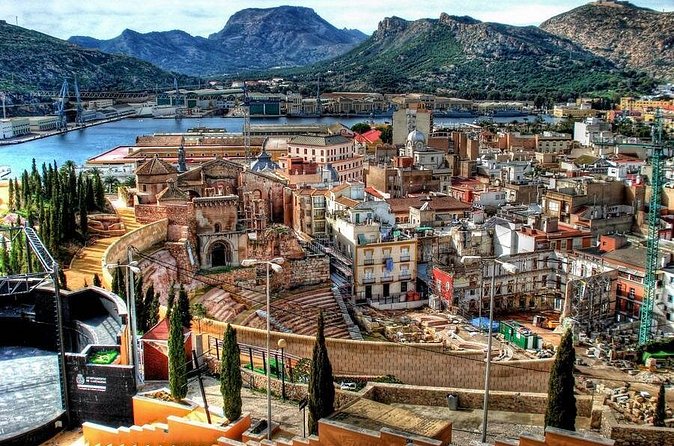
The Cerro del Molinete Archaeological Park marks the location of the Roman forum, near present-day San Francisco Square. The forum sat at the crossing of major roads and formed the civic center of Carthago Nova.
Excavated remains include a temple dedicated to Jupiter, Juno, and Minerva, the Augusteum, the curia, baths, a palestra, and a temple of Isis. These fragments help you picture more than individual buildings. They show the political, religious, and social machinery of a Roman city.
The stop lasts about 40 minutes, with free admission. The park is best appreciated with a guide because exposed foundations can be hard to read without a plan. Ask how the forum related to the theater and the main roads. That connection turns separate ruins into a picture of a functioning city.
You should also expect an outdoor archaeological setting rather than a polished indoor museum. Comfortable shoes and protection from the sun make sense, though the tour information does not specify a footwear or weather requirement.
The Punic Wall and Cartagena’s Carthaginian beginning
At the Punic Wall, the story moves back before Roman rule. General Hasdrubal founded Qart Hadast in 229 BC, and the wall is one of the few surviving Carthaginian remains in Spain.
This is where the tour connects Cartagena to the Punic Wars between Carthage and Rome. The site is not large, with about 15 minutes allotted, but its importance is much greater than its short visit suggests. You are looking at one of the rare physical traces of the city’s Carthaginian foundation.
Admission is not included. Next to the wall is the burial crypt of the Hermitage of San José, built in the 16th and 17th centuries. Its walls contain a distinctive Dance of Death painting program, adding a later Christian layer beside the ancient military remains.
This stop rewards a good explanation more than a long visit. Without context, a section of wall and a crypt may feel disconnected. With the guide’s help, the site becomes a quick lesson in how Cartagena changed hands and beliefs across centuries.
ARQUA and the Odyssey treasure
The National Museum of Underwater Archaeology, known as ARQUA, is the final major museum stop. Its work covers the study, protection, conservation, research, and public presentation of Spain’s underwater cultural heritage.
The museum also safeguards the Odyssey treasure, the collection recovered from the frigate Nuestra Señora de las Mercedes. It includes more than 570,000 gold and silver coins from the late 18th and early 19th centuries.
That collection gives the museum a powerful focus, but ARQUA is about more than precious metal. It shows why objects recovered from the sea need careful study and protection. Shipwreck material can tell you about trade, warfare, technology, and the movement of wealth across the water.
The planned visit lasts 45 minutes. Admission is not included, so budget for it along with the Punic Wall and any castle entry. If you have a strong interest in archaeology, you may want to spend longer here and shorten one of the other stops.
The guide, driver, and language question
The guide is an official local guide for four hours, and the private format means your group receives direct attention. David is the named guide in the available feedback, and his strengths are described as warmth, clear historical storytelling, and a pace that suits older visitors.
English performance may not be identical for every departure. One account describes a guide who struggled somewhat with English, so I would confirm that an English-speaking official guide is assigned before the day of the tour.
The vehicle and driver are useful for the hilltop viewpoint and for keeping a port-day schedule on track. One past complaint described a rude driver and a language problem involving an English-speaking customer and a Spanish-speaking driver. The provider replied that the driver had been removed from the company. That response addresses the specific incident, but it also gives you a reason to confirm the current arrangement and make sure the driver can communicate basic pickup details in English.
What $487 per person really buys
At $487 per person, this is not a bargain sightseeing tour. The price pays for a private vehicle, driver, official guide, port or hotel pickup and drop-off, local taxes, and the included Roman Theater Museum admission.
The value improves when several people share the private arrangement, especially if you want a flexible pace or have limited time in port. A private group can also avoid the compromises of a large excursion, such as waiting for late arrivals or spending time at stops that do not interest you.
The value is weaker if you are a solo visitor or a couple mainly interested in walking the compact historic center. Several admissions are extra, and four hours passes quickly. You are paying for convenience, transport, and personal attention as much as for the sights themselves.
Group discounts are offered, but the details are not provided, so ask for the total price for your party before booking. Food and drinks are not included.
Who should book this Cartagena excursion
I would recommend this tour to cruise passengers who want one organized half-day covering several different sides of Cartagena. It is especially suitable if you want the Roman Theater explained properly, prefer private transport, or need pickup and return at the cruise port.
It also fits families or small groups with mixed interests. One person can enjoy naval and underwater archaeology, another can focus on Roman ruins, and everyone gets the castle viewpoint and old-center architecture.
I would hesitate if your main goal is a leisurely museum day. The schedule is full, some admission fees are extra, and the private price is high. I would also confirm the guide’s English level and the driver’s language ability before paying, since communication is central to a tour with this many moving parts.
Free cancellation is available up to 24 hours before the local start time. After that point, the payment is not refunded, and late changes are not accepted.
FAQ
Where can the tour pick me up?
Pickup and drop-off are available at the Cartagena cruise port, a hotel, or another place of your choice in Cartagena.
How long does the excursion last?
The private tour lasts approximately four hours, including the private vehicle, driver, and official guide.
Is the Roman Theater Museum admission included?
Yes. Admission to the Roman Theater and its museum is included in the tour price.
Are all entrance fees included?
No. The Roman Theater admission is included, but other entrance fees, including those for listed sites where applicable, are not included.
Is the tour private?
Yes. Only your group participates in the activity.
Can I cancel for a full refund?
Yes, if you cancel at least 24 hours before the local start time. Cancellations made less than 24 hours before the start are not refunded.
Should you book it?
Book this excursion if you want a tightly organized introduction to Cartagena and value a private guide, car, and port pickup more than a low price. The Roman Theater, Punic Wall, Molinete ruins, and ARQUA give you a strong sense of the city’s Roman, Carthaginian, medieval, naval, and underwater past.
Skip it if you prefer to explore slowly or mainly want a free walking day. Before booking, confirm the assigned English-speaking guide, ask which non-included admissions you want to add, and make sure your group size makes the $487 price worthwhile. For a small group with limited time, the convenience can justify the cost.
More private car and driver hires in Spain
- Private Shore Excursions to Rome from Civitavecchia Cruise Port with Driver
★ 5.0 · 118 reviews - Airport Pickup By Private Car.
★ 4.5 · 25 reviews - Private shore excursion from Zeebrugge to Bruges with driver and guide
★ 4.0 · 12 reviews - 8 Hour Private Excursion Cruise Ship Pick up Tour Driver & Guide
★ 5.0 · 11 reviews
Newly added around Spain
- Tour to Timanfaya, La Geria and Laguna Verde for cruise passengers★ 4.5 · 28 reviews
- Tour of Jameos del Agua Viewpoint and Valley of 1000 Palm Trees for cruise passengers★ 3.0 · 2 reviews
- Tour to César Manrique Foundation, Cactus Garden and Teguise for cruise passengers★ 4.5 · 8 reviews
- La Graciosa Island Tour for Cruise Passengers from Lanzarote★ 4.5 · 12 reviews
- La Coruña Shore Excursion (Private)CITY TOUR★ 5.0 · 3 reviews
- Private 4 hour Tour of A Coruña with Hotel or Cruise Port pick-up★ 5.0 · 8 reviews
- Private City Tour of A Coruna – Shore Excursion★ 3.5 · 3 reviews
- Costa da Morte/Finisterre from La Coruña Private Tour/Shore excursion★ 5.0 · 9 reviews
Spain Shore Excursions, compared.
Timanfaya and Green Lagoon for Cruise Passengers
Read our review →
Timanfaya And El Golfo For Cruise Passengers (Mornings)
Read our review →
Fuerteventura: Corralejo Sand Dunes Guided Shore Excursion
Read our review →
Fuerteventura: North of Fuerteventura for Cruise Passengers
Read our review →
Shore Excursion: Barcelona City Tour Hop-On Hop-Off
Read our review →
Best of Barcelona Shore Excursion & Sagrada Familia Skip the Line
Read our review →
Best of Barcelona Excursion with Optional Attractions Tickets
Read our review →Browse the lists this tour appears in