
REVIEW · SHORE EXCURSIONS WITH PORT PICKUP
Split and Trogir Half Day Tour from Split (with port pickup)
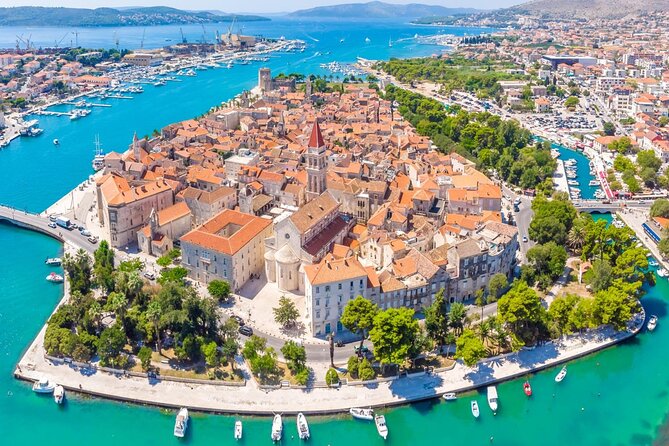
Trogir’s stone lanes and Split’s Roman palace give you two very different Croatian towns in one compact outing. In Trogir, you’ll see a small medieval center shaped by Greek, Roman, and Venetian rule. In Split, ancient palace walls still form the bones of the modern city.
I like the port pickup and the air-conditioned coach, especially when you have only one day ashore. I also like the guides’ local approach. Tina, Sandra, Roko, and Hrvoje are repeatedly praised for clear storytelling, humor, and personal knowledge of Croatia. The main drawback is time: four hours goes quickly, and this is a walking tour with several stops, not a slow day at the seaside.
Key points to know before booking
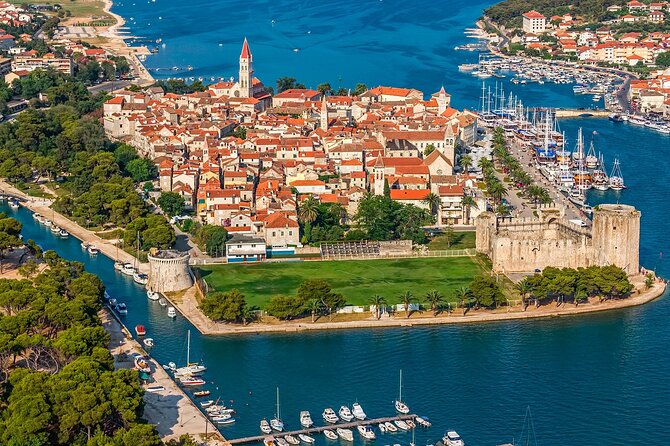
- Two UNESCO-listed old towns in one morning: Trogir and Split offer different styles of architecture and urban life.
- Cruise-port friendly: Meet at the New Split Berth for Cruising Ships and finish in Split’s city center, about a 20-minute walk from the terminal.
- Strong guide element: Tina, Sandra, Roko, Hrvoje, and other Croatian Trails guides are praised for history, humor, and thoughtful help in hot or rainy weather.
- Expect a brisk pace: The tour lasts about four hours and includes substantial walking over old stone streets.
- Entry tickets cost extra: Food, drinks, and admissions are not included.
- Best for first-time visitors: You get a useful introduction to two major Dalmatian sights without arranging transport yourself.
Why this half-day route works from Split
The clever part of this outing is the pairing. Trogir is compact, elegant, and easy to cover on foot. Split is larger and more layered, with Roman walls, medieval lanes, Venetian touches, and modern cafés all sharing the same center.
You do not spend the morning figuring out bus schedules or negotiating a taxi from the port. A guide meets you near the cruise terminal, then an air-conditioned vehicle handles the ride. That matters in summer, when the heat can make even a short transfer tiring.
The tour is sold as roughly four hours. That is enough for an introduction, but not enough for every church, tower, museum, and side street. I would treat it as a well-organized orientation rather than a full study of either town.
The maximum group size is 50, though some departures have been much smaller. A smaller group makes it easier to hear the guide and ask questions. Still, you should be prepared for a group-tour rhythm, with set meeting times and limited flexibility.
More Shore Excursions with Port Pickup in Croatia:
- Mykonos Shore Excursion with Pickup from Cruise Ship Terminal
★ 4.5 · 766 reviews - Mykonos Small Group Tour for Cruise Passengers — Port Pickup
★ 5.0 · 597 reviews - Mykonos: Small Group Tour for Cruise Passengers —Port Pickup
★ 4.9 · 292 reviews
Trogir first, where centuries fit into a small center
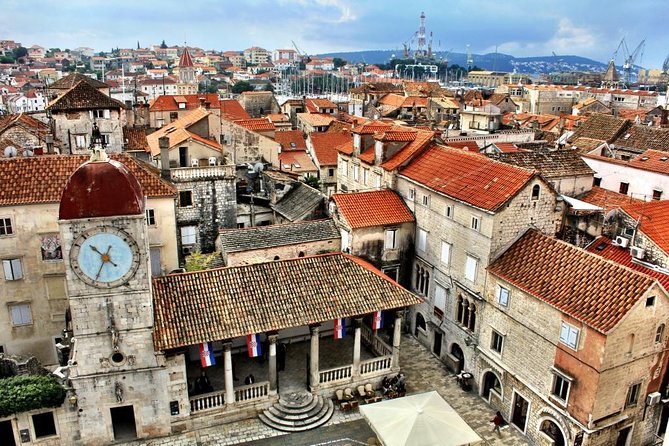
The day begins with a short coastal ride to Trogir. Founded by Greek colonists in the third century BC, the town has more than two thousand years of continuous urban life. That long story is easy to grasp because the historic center is small enough to cross on foot.
Your hour in Trogir focuses on the old town’s stone lanes and major monuments. Romanesque churches sit near Renaissance and Baroque buildings from the Venetian period. The result is not a museum frozen behind glass. It is a working town center, with shops, cafés, and places to pause during free time.
I like Trogir as the first stop because it gives you a clear sense of Dalmatian architecture before Split becomes busier and more complex. You can look closely at carved stone details, narrow lanes, and old façades without needing a map for every turn.
The time is short, so listen closely during the guided portion. You may have some freedom to browse or get a snack, but this is not enough time for a leisurely meal. One useful tip from the guide experience is to take recommendations for local food or gelato seriously, especially if your schedule allows a quick stop.
Saint Lawrence Cathedral
Saint Lawrence Cathedral is Trogir’s grandest monument. Its construction lasted several centuries, so the building shows Romanesque and Gothic forms along with later Dalmatian styles.
The cathedral is listed as a free stop in the tour plan, but the package does not include entry fees where admission is charged. Ask your guide what is included on your departure before assuming you can enter every interior or tower.
The building is valuable even if you only see it from outside. Its long construction history helps explain why Trogir feels architecturally layered rather than uniform. You are looking at a building shaped by changing tastes, rulers, and generations of craftspeople.
Kamerlengo Fortress
Kamerlengo Fortress occupies a strong position near the water and was built in the mid-15th century. It expanded an earlier defensive tower and later became a setting for summer performances.
The stop is scheduled for about 20 minutes. That gives you time to appreciate the fortress walls and setting, but probably not enough for a long visit if you want to explore every corner. Admission is not included, so budget for a possible extra ticket.
The fortress also gives the tour a useful change of pace. After churches and elegant façades, you see the military side of Trogir, a town that needed protection as power shifted around the Adriatic.
More shore excursions in Croatia:
- Split and Trogir Half Day Tour from Cruise Ships
★ 4.8 · 599 reviews - Split and Trogir private tour *ideal for cruise ship guests*
★ 5.0 · 210 reviews - Dubrovnik Shore Excursion: Explore Dubrovnik by Cable Car (ticket included)
★ 4.5 · 109 reviews - Private Krka Waterfalls with Wine and Prosciutto Shore Excursion
★ 5.0 · 98 reviews
Split’s Roman palace is still a living city
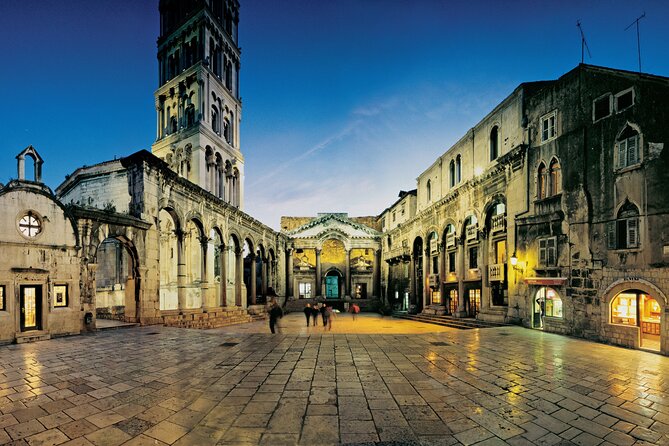
After Trogir, the tour turns to Split and the Palace of Diocletian. This is not a separate ruin outside town. The palace forms roughly half of Split’s old center, with homes, shops, restaurants, passageways, and public spaces inside and around its ancient structure.
Roman emperor Diocletian built the palace at the turn of the fourth century AD. The most interesting fact for a first visit is how ordinary city life continues inside this imperial shell. You walk through old stone gates and courtyards, then find modern businesses tucked into spaces that began as part of a Roman complex.
The palace visit is listed at about 20 minutes, with admission not included. That timing suggests a guided introduction rather than a complete archaeological visit. You will get the basic structure and story, then may have a little time to look around on your own depending on the group and traffic.
This is the portion where a strong guide makes a real difference. Tina is praised for detailed explanations, humor, and an ability to keep the group together in hot weather. Sandra is noted for practical recommendations about restaurants and shops. Roko and Hrvoje are also praised for bringing the history to life in a friendly way.
The quality of the guide matters here because Split’s center can seem confusing at first. Roman walls have been reused, altered, and built around. A guide helps you understand what you are seeing instead of reducing the palace to a collection of old stones.
Cathedral of Saint Domnius
The Cathedral of Saint Domnius is one of Split’s most unusual buildings because the cathedral complex began as an imperial Roman mausoleum. The church itself is dedicated to the Virgin Mary, while the bell tower is dedicated to Saint Domnius.
The tour allows about 20 minutes here. Entry is not included, so you may need to pay separately if the schedule and ticket conditions permit a visit. The outside alone shows the odd mix of Roman and Christian history, but the interior and bell tower are the parts to ask about if you want more than a quick look.
Do not expect a long independent climb or extended museum visit within this half-day format. The value is in understanding the building’s unusual origin and its place within the palace complex.
Prokurative and Split’s Venetian influence
Prokurative offers a different face of Split. Built in the 19th century under General Marmont and promoted by mayor Antonio Bajamonti, the square was inspired by Italian architecture and resembles St. Mark’s Square in Venice.
You get about 15 minutes here, and admission is free. It is a short stop, but it helps connect Split’s Roman past to later Adriatic influences. The city was not shaped by one era alone. Roman, medieval, Venetian, French, and modern periods all left marks.
This is also a useful place to note the tour’s balance. The morning is not limited to ancient ruins. You see how Split continued to grow and change long after Diocletian’s time.
The guide can make or break the morning

The strongest part of this tour is the human element. Tina receives especially warm praise for her energy, humor, English, and ability to adjust to the group. She is also described as a local school teacher, which helps explain the clear, organized way she handles complicated history.
Sandra is praised for being personable and for offering useful suggestions during free time. Roko is described as fun and professional, while Hrvoje is praised for explaining both towns well. The exact guide depends on the departure, so you cannot book with certainty around one individual unless the operator confirms it.
The guides also appear willing to respond to real conditions. One account describes a guide checking on the group during very hot weather. Another describes a guide keeping the day worthwhile in pouring rain. That does not remove the need for sensible clothing, but it is reassuring on a tour that operates in all weather.
There is one important caution: communication about pickup time must be exact. Cruise passengers need to provide the ship name, docking time, disembarkation time, and re-boarding time when booking. The pickup can depend on those details, and one disputed departure involved confusion over a 9:00 AM versus 10:30 AM start.
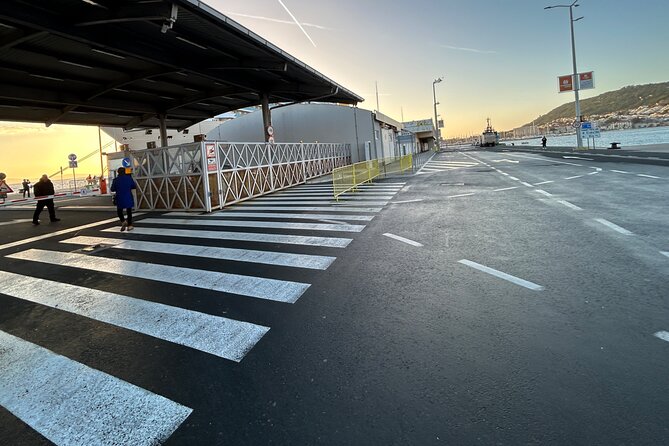
Read the final instructions sent through Viator and follow them closely. At the terminal, look for a Croatian Trails sign near the entrance, beside the red hop-on hop-off buses and past the fence as you leave the ship. Do not rely on general directions from other people at the port.
Price, walking, and what you actually receive
At $78.61 per person, the price is reasonable if you value convenience and live guiding. You are paying for port pickup, a vehicle, guide commentary, and a route that connects two important towns without separate planning.
The value drops if you mainly want free time. You will not receive food, drinks, admission tickets, or a return transfer to the ship. The tour ends at Split Riva, in the city center, and the walk back to the cruise terminal takes about 20 minutes. A taxi can be arranged with help from the guide if needed.
You should also budget for any ticketed interior you want to enter. Since entry fees are excluded, carry a payment method and ask about the current admission arrangements on the day.
Walking is a real part of the outing. The old centers use stone paving, and you move between several monuments in a limited time. A moderate fitness level is requested. Wear shoes with good grip, bring water, and dress for the weather. In summer, a hat and sun protection will make the morning easier. In rain, the old streets can be slippery.
Who should book this tour
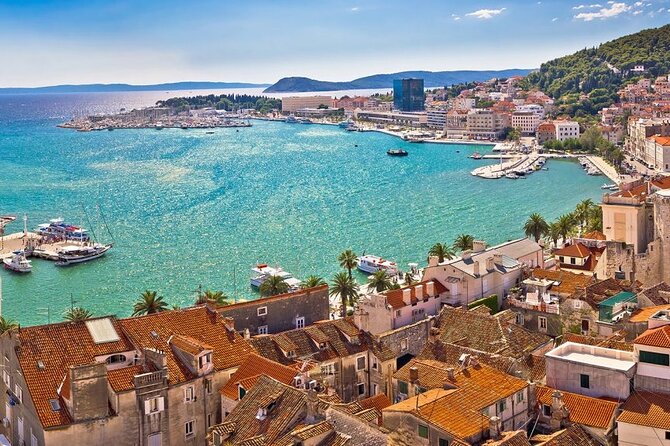
I would choose this for a cruise passenger making a first visit to Split. It removes the hardest logistics and gives you a quick look at Trogir, which is difficult to fit into a short port call without organized transport.
It also suits couples, families with older children, and friends who want history explained rather than simply photographed. The guides add context, and the free portions give you at least some room to browse or choose a snack.
I would not choose it if you want a slow, private day. The maximum group size is 50, the stops are tightly timed, and the tour does not return you directly to the ship. Someone with mobility concerns should also think carefully about the walking and uneven old-town surfaces.
Free cancellation is available until 24 hours before the start time. Late cancellations and changes are not accepted, and a missed tour caused by a late or absent cruise ship does not qualify for a refund. The activity also requires a minimum number of participants, though a cancellation for that reason comes with an alternative or full refund.
Should you book Split and Trogir in four hours?
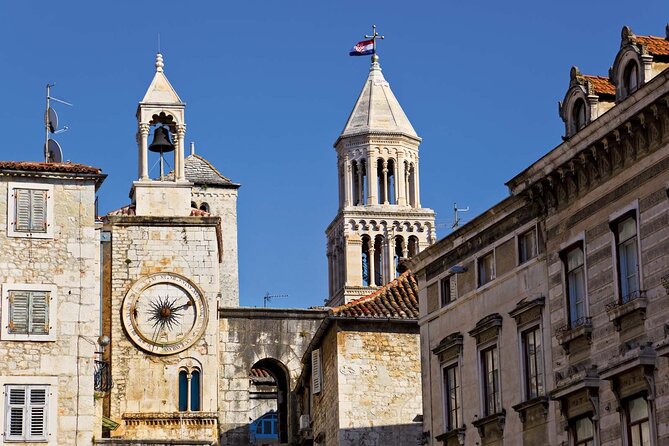
Book it if your goal is to make good use of a cruise stop and understand the basic story of two major Croatian towns. The combination of Trogir’s compact Venetian-era center and Split’s Roman palace gives you a strong first look at the region.
The best reason to go is the guide. Tina, Sandra, Roko, Hrvoje, and the other Croatian Trails staff appear to bring the warmth and local perspective that make a short history tour work. The best reason to hesitate is the pace. Four hours, several monuments, walking, and no ship-terminal drop-off require you to stay organized.
For a first visit, I think the convenience is worth the $78.61 price. Just confirm your pickup details, leave room in your schedule for the walk back to the port, and think of the tour as an introduction that may leave you wanting a longer return visit.
FAQ
How long does the Split and Trogir tour last?
The tour lasts approximately four hours.
Where does the tour begin?
Cruise passengers meet at the New Split Berth for Cruising Ships, Obala kneza Domagoja 16, Split. The guide carries a Croatian Trails sign and waits near the terminal entrance beside the red hop-on hop-off buses.
Where does the tour finish?
The tour ends at Split Riva in the city center. The cruise terminal is about a 20-minute walk away, and the guide can help you find a taxi if needed.
Is transportation included?
Yes. Port pickup, an air-conditioned vehicle, and live commentary are included.
Are food, drinks, and entry fees included?
No. Food, drinks, and admission fees are not included in the tour price.
What information must cruise passengers provide when booking?
You must provide your ship name, docking time, disembarkation time, and re-boarding time.
Does the tour operate in bad weather?
Yes. The tour operates in all weather conditions, so you should dress appropriately.
Can I cancel for a full refund?
Yes, if you cancel at least 24 hours before the scheduled start time. Cancellations or changes made less than 24 hours before the start are not refunded or accepted.
Newly added around Croatia
- Total Game of Thrones Shore Excursion★ 5.0 · 4 reviews
- Dubrovnik Shore Excursion: City Walls Walking Tour (entrance ticket included)★ 4.5 · 28 reviews
- Dubrovnik Shore Excursion: Old Town Walking Tour★ 4.0 · 16 reviews
- Dubrovnik Coast and Cavtat Shore Excursion★ 4.0 · 8 reviews
- Dubrovnik Above Beyond, Srdj drive & guided Old Town PRIVATE SHORE EXCURSION★ 5.0 · 48 reviews
- Dubrovnik Private Shore Excursion: Dubrovnik Old Town, Konavle Valley and Sivi Soko Viewpoint★ 5.0 · 2 reviews
- From SPLIT Cruise Port: Exclusive Tour of Split and Trogir★ 5.0 · 2 reviews
- Split and Trogir SMALL GROUP Tour with Cruise Ship Drop Off★ 5.0 · 7 reviews
Shore Excursions with Port Pickup, compared.
Mykonos Shore Excursion with Pickup from Cruise Ship Terminal
Read our review →
Mykonos Small Group Tour for Cruise Passengers — Port Pickup
Read our review →Small Group Tour for Cruise Passengers —Port Pickup
Read our review →
Port Elizabeth: Schotia Game Reserve Safari with Port Pickup
Read our review →
Kochi Sightseeing Tuk-Tuk Tour with Pickup From Cruise Ships
Read our review →
Kochi Tuk-Tuk Sightseeing Tour with Cruise Ship Pickup
Read our review →
Kochi Tuk-Tuk Private Tours with Pickup from Cruise Ships
Read our review →
Kochi Tuk-Tuk Tour with Pickup From Cruise Ships
Read our review →Browse the lists this tour appears in